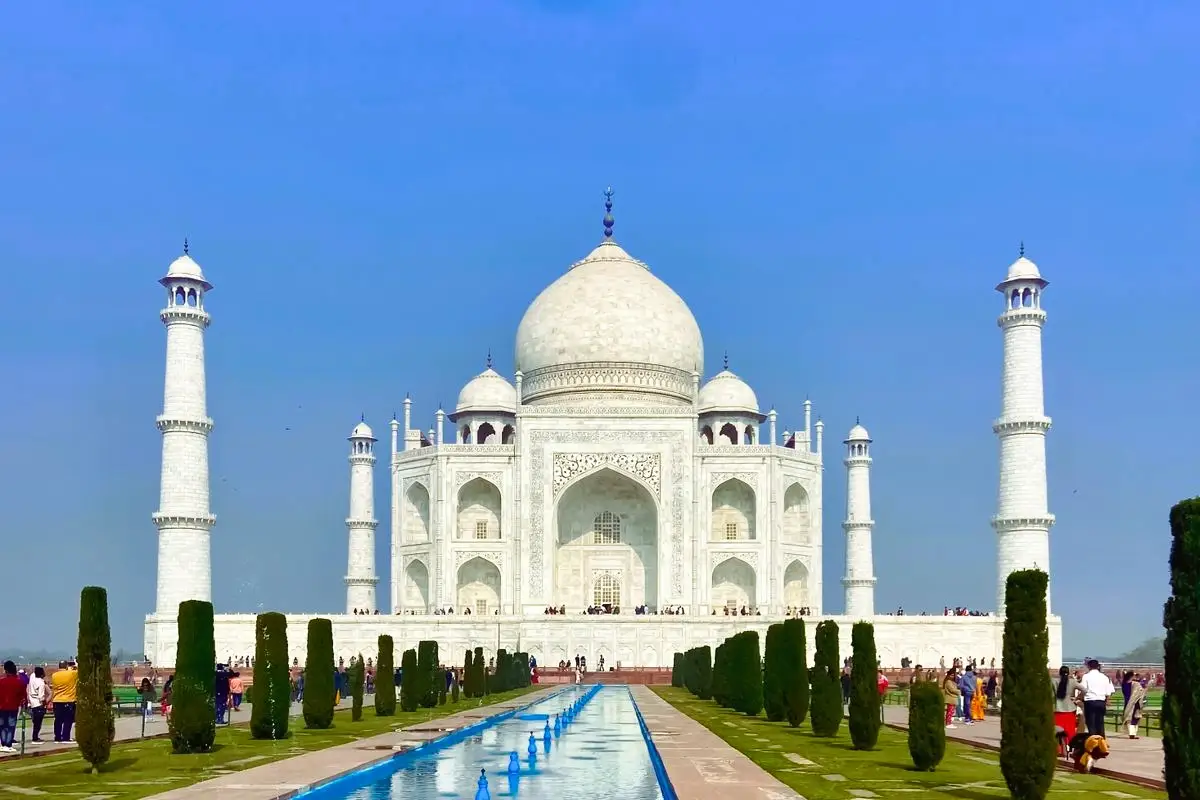
Taj Mahal Visiting Guide: Timings, Tickets, Rules & Mistakes
At a Glance ⭐
- Destination: Agra, Uttar Pradesh, India
- Location: Tajganj, Agra, on the southern bank of the Yamuna River
- Recognition: UNESCO World Heritage Site; New 7 Wonders of the World
- Visit duration: 2-3 hours for a standard visit; longer for dedicated photography
- Opening hours: 30 minutes before sunrise until 30 minutes before sunset
- Weekly closure: Closed every Friday for general daytime viewing
- Entry fee: Tiered by nationality (Foreign Tourist Tier, SAARC/BIMSTEC Tier, Domestic Tier); mausoleum access costs an additional fee on top of base entry
- Best visiting time: Early morning, shortly after gate opening, on a weekday
- Official website: tajmahal.gov.in
Overview
The Taj Mahal in Agra is a heavily regulated monument complex, not a casual walk-in attraction. Entry runs through timed tickets, nationality-based queues, mandatory security screening, and a fixed visit-duration allowance. This Taj Mahal Visiting Guide is built for travelers who need the physical mechanics of a visit worked out in advance: which gate to use, how tickets translate into actual entry, what gets confiscated at screening, and how the site behaves differently on a Friday, a full-moon night, or a monsoon morning.
Visitors should expect a multi-stage entry process. A journey to the monument typically involves reaching a vehicle-restricted zone by shuttle, clearing a security checkpoint comparable to airport screening, and only then reaching the ticket-verification point at the gate itself. Crowd density shifts sharply by hour and by day, and the gate a visitor chooses affects both queue length and how much walking follows.
Planning The Visit
- Best season: October through March offers cooler daytime temperatures and clearer air quality; visibility of the marble facade drops noticeably during Agra’s heavy pre-monsoon haze in May and June.
- Best time of day: The first hour after gate opening carries the lowest crowd density of the entire day, even below sunset hours, because most tour groups arrive mid-morning.
- Average visit duration: Budget an additional 30-45 minutes beyond the walkthrough itself for security queues during peak season, on top of the 2-3 hour visit window.
- Peak crowd periods: Weekends, national holidays, and the week around major Indian festivals see the sharpest queue buildup at both entry gates.
- Weather considerations: Marble surfaces reach uncomfortable surface temperatures by midday in summer; sunrise visits avoid this and also avoid the worst of Agra’s humidity spike after 10 AM.
- Advance booking recommendations: Online booking is the only route to guaranteed night-viewing slots and removes exposure to at-gate ticket-counter queues, which lengthen unpredictably during high season.
Getting There
By Air
Agra’s airport sits roughly 7 km from the city center. Flight frequency to Agra fluctuates by season, with fewer direct routes operating outside peak tourist months. Confirming current routes directly with an airline or travel desk is advisable before booking, since seasonal schedule changes are common.
By Train
Agra is served by three stations: Agra Cantonment (the primary hub), Raja-ki-Mandi, and Agra Fort. Agra Cantonment handles the bulk of long-distance and express services. Key routes connecting Delhi to Agra include the Gatimaan Express and Shatabdi Express, both same-day options suited to day-trip logistics. Reservation status and timetables should be checked directly through India’s official rail booking system, since schedules shift with seasonal timetable revisions.
By Road
Agra sits inside the Delhi-Agra-Jaipur tourist circuit and connects to Delhi via a dedicated expressway. Approximate road distances:
- Delhi → Agra: ~204 km
- Jaipur → Agra: ~232 km
- Gwalior → Agra: ~119 km
- Mathura → Agra: ~56 km
The expressway drive from Delhi typically runs 3-3.5 hours by private car, making a sunrise arrival require a pre-dawn departure. Regular interstate bus services connect Agra to Delhi, Jaipur, and Mathura through the city’s main bus terminals.
Local Transport, Parking, and the Final Stretch
Private and hired vehicles cannot approach the monument directly. A 500-meter pollution-control buffer zone bans combustion vehicles around the complex, so all visitors transfer to battery-operated buses, golf carts, or foot for the final stretch. Two parking areas serve the two active gates:
- Shilpgram parking serves the Eastern Gate.
- Amrood ka Teela parking serves the Western Gate.
From either lot, the walk to the gate covers close to 1 km, and battery buses or golf carts cover that distance for visitors who prefer not to walk it. Auto-rickshaws, cycle rickshaws, and prepaid taxis operate throughout Agra city for the wider journey between hotels and the parking zones.
Entry Process
Three gates exist, but only two admit visitors:
- Eastern Gate: Full entry access; generally the better-equipped gate for mobility assistance.
- Western Gate: Full entry access; ticket counter located near Saheli Burj.
- Southern Gate: Exit only. No entry permitted here under current rules.
⚠️Warning: Arriving at the Southern Gate expecting to enter will result in a redirect to one of the other two gates, costing significant time during peak hours.
Separate queues operate for foreign nationals and domestic/Indian visitors at both active gates, with signage directing each group accordingly. At the checkpoint, staff verify the ticket (paper or QR code) against a valid photo ID matching the name on the booking. Security screening follows a standard comparable to airport protocols: bag scanning, a walk-through or handheld metal detector, and a manual bag check. Screening intensity and queue length increase substantially during weekend and holiday periods.
Visitors receive an entry-linked time allowance, typically enforced around a 3-hour ceiling from the point of entry. Re-entry on the same ticket is not standard; visitors who exit before completing their visit should confirm re-entry terms with gate staff before leaving, since policy on this can vary by day and by gate.
Tickets & Booking
Booking Tickets Online or at the Gate
| Visitor Category | Base Entry | Mausoleum Add-On |
|---|---|---|
| Foreign Tourist Tier | Higher tier rate | Available as optional add-on |
| SAARC/BIMSTEC Tier | Reduced tier rate | Available as optional add-on |
| Domestic Tier | Lowest tier rate | Available as optional add-on |
| Children below 15 years | Free | Free |
📌Note: Base tickets grant access to the grounds, gardens, and exterior platform only. A separate Mausoleum Add-On ticket is required if visitors want to go inside the main mausoleum.
Tickets can be purchased two ways:
- Online: Through the official ASI ticketing portal (asi.payumoney.com) or the affiliated asiagracircle.in platform, both referenced by the official tajmahal.gov.in site. Payment completes via standard online methods, and confirmation arrives as a QR-coded e-ticket.
- At the gate: Ticket counters operate at both the Eastern and Western Gates, opening one hour before sunrise and closing 45 minutes before sunset. Gate-counter purchases accept cash and, at most counters, card payment.
💡Tip: Booking online in advance is the more reliable route during high season, since at-gate counter queues can extend well beyond the time saved by skipping online registration.
Night Viewing
Night viewing exists and operates on a restricted schedule: five nights per month only, covering the full moon night plus two nights before and two nights after. Sessions run from 20:00 to 23:59, split into eight batches, each capped at roughly 50 visitors and lasting 30 minutes. Visitors must report to Shilpgram, near the Eastern Gate, 30 minutes ahead of their assigned batch time for a separate security check. Valid photo ID is mandatory for every attendee. Night-viewing tickets are sold under their own separate tier structure. This schedule is closed entirely on Fridays and throughout the Islamic month of Ramzan.
Visitor Guidelines
- Dress code: No strict enforced code exists, but modest clothing covering shoulders and knees is the practical norm and avoids unwanted attention at security or inside the complex.
- Photography/videography rules: Still cameras are permitted throughout the outdoor complex.
- ✅ Still photography in gardens, platform, and exterior areas
- ❌ Photography inside the main mausoleum chamber
- ❌ Drone or aerial camera use, anywhere in or around the complex
- ❌ Tripod use for standard visitor tickets without prior special permission
- Prohibited items (strict list):
- ❌ Food items, including small snacks and confectionery
- ❌ Tobacco products, lighters, and smoking materials
- ❌ Arms, ammunition, and any flame-producing item
- ❌ Headphones, power banks, and non-camera electronic goods
- ❌ Knives, wire, and similar sharp or restricted objects
- ✅ A single water bottle (up to half a litre is explicitly permitted)
- ✅ A still camera without a tripod
- Bag policies: Large bags and books slow down screening significantly and are best left at the hotel or in the vehicle rather than carried to the gate.
- Food & drink rules: Eating and smoking are prohibited throughout the monument grounds, including the gardens.
- Expected behavior: Silence is expected inside the mausoleum chamber, and touching or scratching any marble surface is explicitly forbidden due to conservation concerns.
- Special restrictions / guides & photographers: Hired guides and professional photographers should carry visible identification cards; unlicensed operators soliciting near the gates should be avoided in favor of officially credentialed personnel.
Accessibility & Visitor Facilities
| Facility | Status |
|---|---|
| Wheelchair access | ✅ Ramps at garden and platform level; free loaner wheelchairs at gates (refundable deposit) |
| Navigability for elderly visitors | ✅ Battery buses/golf carts cover the parking-to-gate walk |
| Toilets | ✅ Available near both active gates |
| Drinking water | ✅ Bottled water permitted; refill points near gate facilities |
| Cloakrooms/lockers | ✅ Cloak rooms available at both Eastern and Western Gates |
| Seating | ✅ Benches along garden pathways |
| First aid | ✅ First-aid box maintained at the ASI office on site |
| Parking | ✅ Two dedicated lots (Shilpgram and Amrood ka Teela), each roughly 1 km from its gate |
⚠️Warning: The mausoleum interior itself is not wheelchair accessible. Reaching the inner chamber involves a flight of roughly 22 steps with no ramp alternative, so wheelchair users should plan to experience the exterior, platform, and gardens rather than the inner tomb chamber.
During The Visit
After clearing security, visitors typically follow a linear path: through the main red-sandstone gateway, along the reflecting pool, toward the raised marble platform. The framed view through the entrance gateway is the first major photography bottleneck of the day, since nearly every visitor stops there for the same shot.
The platform itself creates a second bottleneck at its four corners, where sightlines toward the minarets draw sustained crowds. Shoe covers, provided free with SAARC, BIMSTEC, and foreign tickets, are required before stepping onto the marble platform; domestic-tier visitors can obtain covers on site as well. The mausoleum entrance queue moves slowly because of the additional ticket check and the narrow chamber interior, so visitors on a tight schedule should budget extra time here rather than elsewhere.
Garden pathways are wide and easily walkable, and this is where wheelchair users and visitors with limited mobility can move most freely, consistent with the ramp access noted in the accessibility section above. The busiest single stretch of the entire visit is usually the final approach to the platform steps during mid-morning hours, when both gate queues have fed into the same central pathway.
Things Worth Knowing
- The Eastern Gate generally clears mobility-assistance requests and wheelchair rentals faster than the Western Gate, due to better ramp infrastructure.
- Mehtab Bagh, across the river from the main complex, offers a full view of the Taj Mahal and typically remains open on Fridays when the main complex is closed.
- A single valid ticket does not guarantee unlimited time inside; the enforced visit window means photographers planning long sessions should treat the 3-hour allowance as a hard planning constraint, not a guideline.
- Third-party “skip-the-line” packages generally bundle a guide or transport add-on rather than delivering faster physical gate access, since any valid ticket — online or at-counter — uses the same queue structure.
- Free-entry days are designated periodically by ASI for occasions such as World Heritage Day; these dates shift year to year and should be checked directly against the official calendar rather than assumed.
💎Expert Insight: Transitioning from the grand scale of Agra’s Taj Mahal to Madhya Pradesh’s legendary medieval temples creates the ultimate Indian heritage itinerary. The Khajuraho Group of Monuments guide maps out how to get there, detailing site entry protocols, ticketing procedures, and seamless transit connections.
Official Resources
- Official website: tajmahal.gov.in
- Official booking page: asi.payumoney.com
- Official visitor information: asiagracircle.in
Disclaimer
Operational details such as hours, fees, closure days, and booking procedures are subject to change without advance notice from the Archaeological Survey of India and Uttar Pradesh Tourism authorities. Travelers should verify all time-sensitive details directly through the official channels listed above before finalizing any visit.