The Angkor Wat Visitor Guide: Entry Rules, Ticket Details and Helpful Tips
👀 At a Glance
| 📍 | Destination: Angkor Wat, within Angkor Archaeological Park |
| 📌 | Location: ~6 km north of Siem Reap, Cambodia |
| 🏛️ | Recognition: UNESCO World Heritage Site (Angkor Archaeological Park) |
| ⏱️ | Visit duration: 2–3 hours for the main temple; half a day with nearby sites |
| 🕒 | Opening hours: Angkor Wat: 5:00 AM–5:30 PM; the wider Angkor Archaeological Park operates on a broader 5:00 AM–6:30 PM access window. The Bakan upper level has separate hours. |
| 📅 | Weekly closure: None; open 365 days a year except from 1:00 PM onward on the 14th and 28th of each month, when access is suspended for conservation work. |
| 🎟️ | Reservation required: Angkor Pass required, purchased before entry |
| 💵 | Entry fee: $37 (1-day), $62 (3-day), $72 (7-day) — Foreign Tourist Tier |
| 🌤️ | Best visiting time: November–February, early morning or late afternoon |
| 🌐 | Official website: Angkor Enterprise® |
📖 Overview
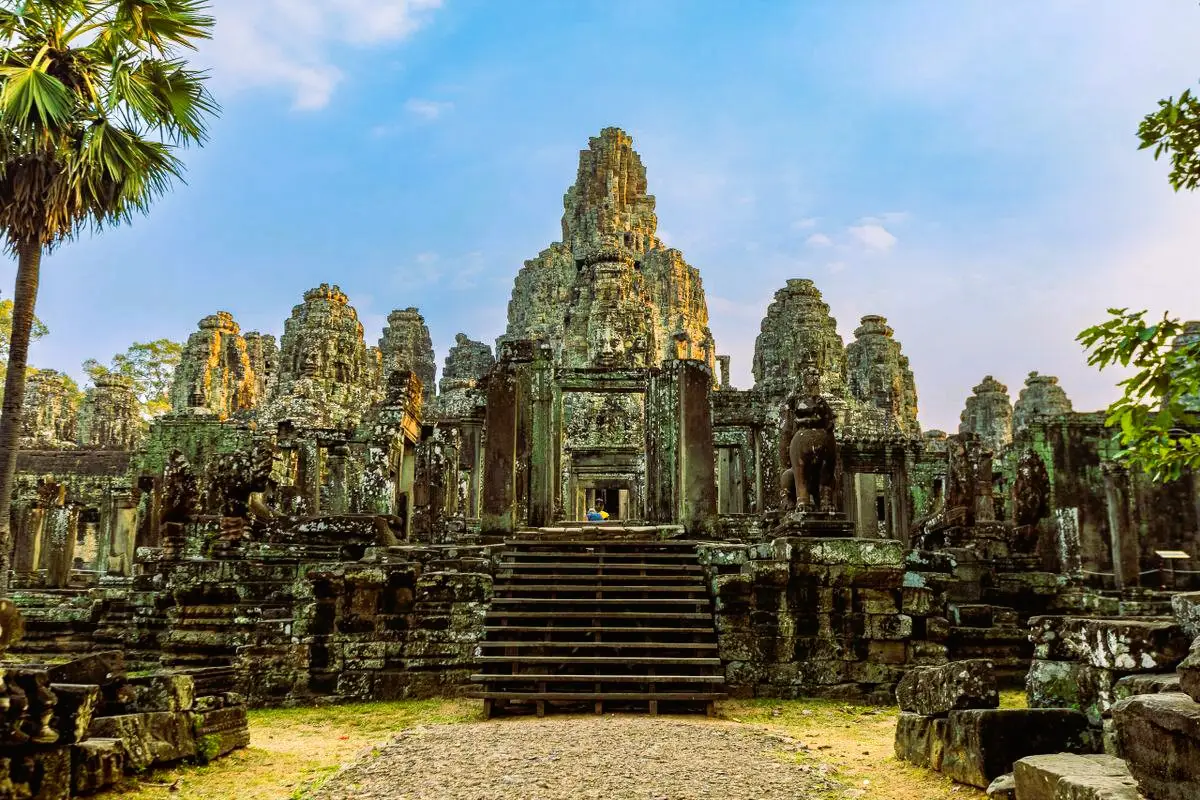
Angkor Wat is the principal temple within the approximately 400-square-kilometer Angkor Archaeological Park, a UNESCO World Heritage property containing a very large network of temples and archaeological features. A single pass covers entry to the whole park, not just this one structure. This Angkor Wat visitor guide targets first-time visitors coordinating ticketing, transport, and timing across a multi-stage system: a separate ticket office, a temple entrance several kilometers away, and internal rules that vary by which part of the structure a visitor wants to reach.
The logistical profile is dense rather than difficult. Sunrise hours draw heavy crowds at the west entrance. The upper sanctuary runs on its own schedule, closes on Buddhist holy days, and has a capacity limit. Visitors who plan around these three variables avoid most on-site friction; those who do not often lose an hour to queuing or find a section closed without warning.
🗓️ Planning The Visit
- Best season: November through February. Dry season keeps humidity lower and reduces the risk of afternoon downpours disrupting a walking itinerary.
- Best time of day: 5:00–6:30 AM for sunrise, or 3:30–5:30 PM for softer light with fewer people. Midday sun between 11:00 AM and 2:00 PM adds significant heat exposure on unshaded causeways.
- Average visit duration: 2–3 hours for Angkor Wat alone; a full day if combined with Bayon and Ta Prohm. A 1-day pass comfortably covers all three if the route starts at sunrise and moves counter-clockwise through the Small Circuit.
- Peak crowd periods: Sunrise hour at the west entrance, and the entire Khmer New Year week in mid-April. The reopened East Gate offers an alternative approach that can reduce exposure to the main west-gate sunrise crowd, although it does not provide the classic west-side reflection view.
- Weather considerations: Wet season (May–October) brings intense but usually short afternoon storms. Stone surfaces near the moat get slick fast; sturdy closed-toe shoes reduce slip risk on wet steps.
- Advance booking recommendations: For sunrise visits, buying online the previous day is convenient and avoids a pre-dawn stop at the ticket office, but advance purchase is not generally mandatory. Same-day purchase after 4:30 PM issues a pass valid for entry the following day, useful for arriving late and visiting early.
📍 Getting There
✈️ By Air
Siem Reap Angkor International Airport (SAI) is the only commercial airport serving the region, located roughly 50 km east of Siem Reap town. There is no rail or direct road link bypassing this transfer point.
- Current official airport shuttle fare: about $8; verify the current timetable before travel.
- Private taxi or hotel transfer: ~$25–$35, ~45–60 minutes depending on traffic.
- The airport sits closer to the temple park than to the town center, so travelers heading straight to Angkor Wat before checking into a hotel should confirm this route with their driver in advance.
🚇 By Train
Cambodia has no passenger rail service connecting Siem Reap to other major cities or to the airport. This mode is not available for reaching Angkor Wat under any circumstance.
🛣️ By Road
Most international and domestic visitors arrive in Siem Reap by air, since overland bus routes from Phnom Penh or Bangkok take 6–8 hours depending on border conditions.
- Phnom Penh to Siem Reap by bus: ~6 hours via National Road 6.
- Bangkok to Siem Reap by bus or shared van, including the Poipet border crossing: ~7–8 hours.
- Self-driving is possible, including rented scooters, although many visitors use tuk-tuks, cars or guided transport for convenience.
Local Transport, Parking, and the Final Stretch
Angkor Wat sits about 6 km from central Siem Reap, a 15–20 minute ride by tuk-tuk.
- Tuk-tuk daily hire: ~$15–$20, includes waiting time between temple stops.
- Private air-conditioned car: ~$25–$50 depending on itinerary length.
- Bicycle rental is available in town for a self-paced ride to the park.
- The main Angkor Enterprise ticket office is on Apsara Road at Road 60, about 4 km from central Siem Reap. An additional Angkor Pavis ticket counter operates near the main Angkor Wat entrance.
- Parking is available near the main entrance; local parking charges can vary, so confirm the current fee on arrival.
- The west sandstone causeway is approximately 200 meters long.
⚠️ Warning: Do not assume every ticket type or purchase method is available at the temple-area counter. Check the current Angkor Enterprise guidance before relying on same-day purchase near Angkor Wat.
➡️ Entry Process
Angkor Wat has four gopura (gate structures) at each cardinal direction, but only the west and east gates cross the moat via causeway and function as visitor entrances.
- West Gate: the main entrance, fronting the widest causeway. Required for the classic sunrise reflection shot over the towers.
- East Gate: a smaller, less ornate entrance with no causeway crowd. Suited to visitors skipping sunrise or arriving mid-morning.
- Ticket / Pass is checked at entry. One-day tickets do not require a photo; 3-day and 7-day passes use a photo for identification.
- Carry the identification document used for ticket purchase, particularly when using a 3-day or 7-day pass.
- Queue times run longest between 5:00 and 5:45 AM at the west gate; the east gate rarely has a queue at any hour.
- Security checks may be conducted at visitor-control points; follow staff instructions regarding bags and restricted items.
- A valid Angkor Pass remains usable during its stated validity period; visitors can leave and return to the park within that period.
🎫 Tickets & Booking
| Tier | Price | Validity |
|---|---|---|
| Foreign Tourist Tier — 1-Day Pass | $37 | 1 entry day |
| Foreign Tourist Tier — 3-Day Pass | $62 | 3 entry days within 7 days |
| Foreign Tourist Tier — 7-Day Pass | $72 | 7 entry days within 30 days |
| Child/Student Concession Tier — Under 12 | Free | Passport required as proof of age |
Cambodian nationals fall under a separate Domestic Tier with different pricing, handled through a distinct counter process not covered by the Foreign Tourist Tier passes above.
Booking method:
- Online through the official Angkor Enterprise portal (ticket.angkorenterprise.gov.kh)
- For 1-Day, no photo required
- For 3-Day & 7-Day, photo required for identification.
- In person at the Angkor Enterprise ticket office on Road 60: a photo is taken on-site with a webcam, and the pass prints immediately.
- Self-service kiosks exist at select locations in town, functioning similarly to the online flow but with in-person photo capture.
- Cash (USD or Cambodian riel) and major credit cards are accepted at physical counters; online payment is card-only.
- All Angkor Pass sales are final. For lost or damaged passes, contact Angkor Enterprise customer support promptly with your receipt or confirmation email.
📝 Note: The pass is non-transferable and carries the holder’s photo, checked at multiple temple entrances beyond just Angkor Wat — sharing a pass among companions is not possible.
Night Viewing
Angkor Wat itself closes at 5:30 PM; the wider park has a 6:30 PM closing window. There is no standard night-viewing program at Angkor Wat.
📋 Visitor Guidelines
- Dress code:
- ✅ Shirts and tops covering the shoulders
- ✅ Trousers, skirts, or shorts reaching below the knee
- ❌ Sleeveless tops or tank tops
- ❌ Shorts or skirts above the knee
- Photography/videography rules: Standard handheld photography is permitted throughout, including the inner sanctuary and bas-relief galleries. Flash use may be restricted near shrine areas at attendant discretion. Commercial filming requires prior authorization.
- Allowed/Prohibited items (strict list):
- ✅ Allowed: Handheld cameras and phones
- ✅ Allowed: Small day bags carried by hand or on one shoulder
- ❌ Prohibited: Drones, without a written APSARA permit obtained in advance
- ❌ Prohibited: Tripods and monopods inside temple structures
- ❌ Prohibited: Backpacks worn inside temple interiors
- ❌ Prohibited: Umbrellas with sharp metal tips
- Bag policies: Large bags or backpacks may be restricted in narrow or sensitive areas; carry only what you need and follow staff instructions.
- Food & drink rules: Eating is not permitted inside temple structures. Bottled water is allowed and recommended given the heat exposure on open causeways.
- Expected behavior: Quiet conversation is expected, since the complex remains an active spiritual site with resident monks. Touching carvings, sitting or leaning on structures, and smoking are all prohibited throughout the park.
- Special restrictions / guides & photographers: Professional or commercial photography and filming require prior written permission from APSARA Authority. Licensed local guides are available for hire near the ticket office and main gates.
⚠️ Warning: Public nudity or exposure at the temple has led to arrest, fines, and deportation in past cases — this is enforced as a criminal matter, not a minor infraction.
♿ Accessibility & Visitor Facilities
| Facility | Status |
|---|---|
| Wheelchair access | ❌ Ground-level galleries only; upper sanctuary has steep stone stairs |
| Navigability for elderly visitors and children | ⚠️ Uneven stone flooring throughout; causeway is flat and manageable |
| Toilets | ✅ Available near the west entrance and parking area |
| Drinking water availability | ❌ No vendors inside; bring water from town or the ticket office area |
| Cloakrooms/lockers | ❌ Not available on-site |
| Seating | ✅ Limited shaded rest areas near the outer gallery |
| First aid | ✅ First-aid services are available in the Angkor Wat visitor/forecourt area |
| Parking | ✅ Free informal parking near the west gate |
⚠️ Warning: The upper sanctuary climb involves elevation on a steep gradient, unsuitable for visitors with significant mobility limitations, vertigo, or cardiac conditions.
👣 During The Visit
Past the entry checkpoint, the west-gate route follows the 350-meter causeway directly toward the temple’s outer gallery, with reflecting pools flanking both sides — the north pool is the standard sunrise photo spot.
- The outer gallery bas-relief corridor runs the full perimeter and holds most crowds in the first hour after sunrise.
- Shoes may need to be removed when entering certain active Buddhist worship spaces or shrines; follow on-site signs and staff instructions.
- The climb to the upper sanctuary (Bakan) has a separate entry point. Access is capped at 100 visitors at a time, and visits are limited to about 15 minutes.
- Bakan opens later than the main complex, so sunrise arrivals cannot access the top tier immediately and should plan the outer galleries first.
- Movement flow works best counter-clockwise from the west entrance through the galleries before attempting the central towers, since this avoids backtracking against the incoming sunrise crowd.
- Shade is limited to gallery interiors; travelers spending extended time outdoors should plan water breaks around the reflecting pool benches.
🔖 Things Worth Knowing
- The east gate sees a fraction of west-gate sunrise traffic and still delivers full access to the same interior galleries and towers.
- Bakan (the upper sanctuary) closes on Buddhist holy days tied to the lunar calendar, independent of the main temple’s daily schedule — this can fall on any day of the week, including weekends.
- Buying a pass after 4:45 PM at the physical counter issues next-day validity, a common workaround for late arrivals wanting an early sunrise start without a 4:30 AM ticket-office queue.
- The 7-day pass costs only $10 more than the 3-day pass, so it can be economical for travelers making multiple temple visits over a longer stay.
- Koh Ker and Phnom Kulen require separate tickets outside the standard Angkor Pass, a detail that surprises visitors assuming full-park coverage.
🔗 Official Resources
- Official Website: Angkor Enterprise®
- Ticket Reservations: Angkor Pass
- Visitor Information: APSARA National Authority
ℹ️ Disclaimer
Operational details such as opening hours, entry fees, and transport pricing are subject to change without notice. Travelers should verify all time-sensitive information directly through official Angkor Enterprise and APSARA Authority channels before finalizing travel plans.