Meenakshi Amman Temple Visitor Guide: Timings, Entry Rules, Dress Code & Common Mistakes
At a Glance ⭐
- Destination: Madurai, Tamil Nadu, India
- Location: Central Madurai (Old Town), Southern bank of the Vaigai River
- Recognition: Major Spiritual Landmark
- Visit duration: 2 to 4 hours for a complete walkthrough
- Opening hours: 5:00 AM–12:30 PM and 4:00 PM–10:00 PM daily
- Weekly closure: None; the temple operates seven days a week
- Entry fee: Free general darshan; paid tiers apply for special darshan and inner-sanctum access
- Best visiting time: Weekday mornings, October to February
- Official website: maduraimeenakshi.hrce.tn.gov.in
Overview
Meenakshi Amman Temple functions as a working place of worship first and a visitor attraction second. Daily ritual schedules, not tourist convenience, dictate when gates open and close. This Meenakshi Amman Temple Visitor Guide is built for travelers who need an execution plan: which gate to use, what gets confiscated at security, how the midday closure affects timing, and where non-Hindu visitors are physically permitted to stand.
Visitors should expect a multi-stage entry process: footwear removal, an electronics ban enforced by X-ray screening, and a walk through several concentric enclosures before reaching any shrine. Crowding is heaviest around ritual times and during the April–May Chithirai festival. First-time visitors without local guidance frequently lose 30–45 minutes to preventable mistakes — carrying a phone to the gate, arriving during the afternoon closure, or misjudging the dress code.
Planning The Visit
- Best season: October through February. Daytime temperatures stay moderate for the walk between enclosures, most of it on stone underfoot without footwear.
- Best time of day: Immediately after the 5:00 AM or 4:00 PM opening Queue volume is lowest in the first hour after each reopening, before tour groups arrive.
- Average visit duration: 2 to 4 hours. This includes security processing, footwear/electronics deposit, and the walk through the Thousand Pillar Hall and outer mandapams.
- Peak crowd periods: Weekends, Tamil festival dates, and the Chithirai Festival window Security screening slows significantly during these periods; allow extra time beyond the standard 2–4 hour estimate.
- Weather considerations: Stone floors reach high surface temperatures by midday in warmer months Barefoot visitors should plan outdoor-facing sections for early morning or after 4:00 PM, when stone has cooled.
- Advance booking recommendations: General darshan needs no booking; special darshan and pooja slots benefit from checking the official portal beforehand Slot availability shifts around festival dates, so confirming timing close to the visit date reduces wasted trips.
Getting There
Meenakshi Amman Temple sits inside Madurai’s old town, reachable by all three major transit modes with the final approach typically completed on foot or by short local transport.
By Air
Madurai Airport (IXM) is the nearest airport, roughly 11–12 km from the temple. Pre-paid taxi counters operate at the arrivals exit; auto-rickshaws are available but require fare negotiation. Drive time runs approximately 25–35 minutes outside festival traffic.
By Train
Madurai Junction is the nearest railway station, approximately 2 km from the temple. It receives direct and connecting services from most major Indian cities. Auto-rickshaws and taxis queue outside the station forecourt; the distance is also walkable in 20–30 minutes for travelers without luggage.
By Road
Tamil Nadu State Transport buses and private operators connect Madurai to major cities across the state. Long-distance buses typically terminate at Mattuthavani Bus Stand, roughly 6 km from the temple, requiring a connecting local ride.
Local Transport, Parking, and the Final Stretch
- Auto-rickshaws and app-based cabs operate throughout the old town and can drop within a short walk of any gate.
- City bus routes serve stops near the temple perimeter from most parts of Madurai.
- Vehicle parking is not available directly at the gates; drivers typically park roughly 100 ft (~30 m) from the entrance and walk in.
- Madurai Junction railway station is the closest major transit hub, at ~2 km.
💡 Tip: Deposit cameras, bags, and electronics inside the parked vehicle before walking to the gate — it removes one queue stop at security.
Entry Process
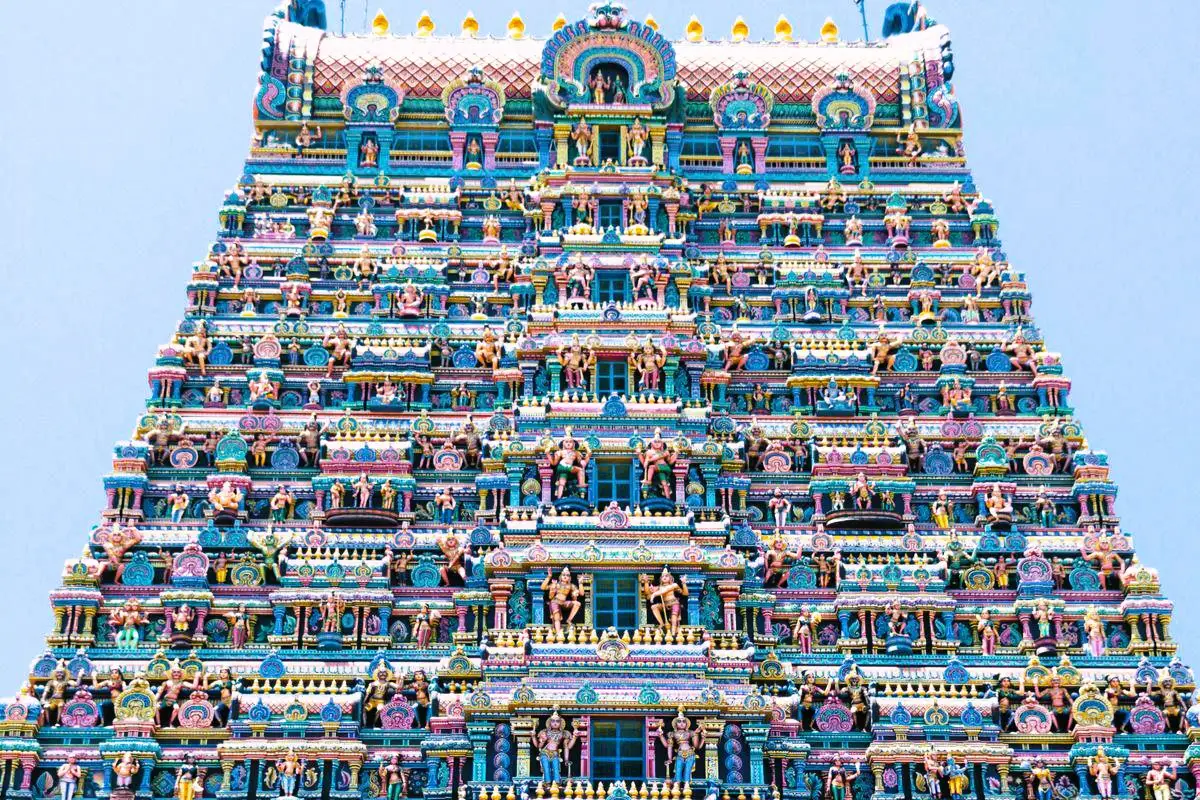
The temple has multiple entrance gopurams; the East Gate (Chitra Gopuram) is the primary entry point for first-time visitors and offers the most direct route to the main halls. During peak hours or festivals, authorities may direct visitors toward the South entrance to balance queue volume across gates.
Sequence at any gate: Footwear counter → Electronics/bag deposit → Security screening → Main concourse.
- Footwear must be removed before the security checkpoint; free footwear-storage counters operate at all main entrances.
- Bags, cameras, and phones are screened and typically must be deposited at a counter near the gate rather than carried through — plan for a short queue at this counter separate from the security line.
- No government-issued ID is required for general darshan entry.
- Security screening includes walk-through metal detection and, at busier gates, X-ray bag screening.
- Re-entry after leaving the complex requires repeating the full sequence, including a fresh electronics deposit.
⚠️ Important Access Note: The outer enclosures, mandapams, and Thousand Pillar Hall are open to all visitors. However, entry into the inner sanctums (garbha griha) of the Meenakshi and Sundareswarar shrines is restricted to practicing Hindus. This access limit is enforced at the internal shrine thresholds, not at the main exterior gates.
Tickets & Booking
Booking Tickets Online or at the Gate
General darshan carries no fee and needs no advance booking. Paid tiers apply to special darshan, sanctum-adjacent viewing, and specific poojas or Abhishekam bookings.
| Tier | Applies To | Booking Method |
|---|---|---|
| General/Free Darshan Tier | Standard visit, all visitors | No booking required |
| Foreign Tourist Tier | Entry to designated viewing points | At-gate counter |
| Special Darshan Tier | Faster access, both deity sanctums | Official portal or gate counter |
| Pooja/Abhishekam Tier | Specific rituals (Archana, Kalyanam) | Official portal booking preferred |
- Online booking runs through the temple’s official e-Services section on the HR&CE portal.
- At-gate payment counters accept cash; card and UPI acceptance varies by counter and should be confirmed on arrival.
- Special pooja and Abhishekam slots are calendar-dependent and subject to change around festival dates — check the live schedule before finalizing a visit date.
Night Viewing
The temple’s evening session runs until 10:00 PM daily, closing with the Palliyarai Pooja procession around 9:15–10:00 PM, when the deity idol is ceremonially returned to its sanctum. This functions as a night ceremony rather than a separate late-night viewing program — entry rules and dress code remain identical to daytime hours.
Visitor Guidelines
- Dress code: The Madurai Meenakshi Amman Temple strictly enforces a traditional dress code. Security personnel at all four gates will turn away visitors whose attire does not meet the temple’s modesty standards.
- For Men:
- ✅ Dhoti (Veshti) or Pyjamas
- ✅ Full-Length Trousers/Pants
- ✅ Shirts/T-shirts (must be half or full sleeves)
- ❌ Shorts, Bermudas, Ripped jeans
- ❌ Caps, hats, and sunglasses
- For Women:
- ✅ Saree or Half-Saree
- ✅ Salwar Kameez or Churidar (must be worn with a dupatta/scarf).
- ✅ Long Skirts/Dresses (must reach the ankles & shoulders must be fully covered)
- ❌ Shorts, Bermudas, Ripped jeans, Caps, hats, and sunglasses
- ❌ Knee-length skirts or dresses, tight leggings
- ❌ Sleeveless tops, tank tops, or crop tops
- Photography/videography rules: Prohibited throughout the temple interior, including with mobile phones. Paid, temple-affiliated photography services operate inside for those wanting images.
- Allowed/Prohibited items (strict list):
- ✅ Allowed: Small handbags and purses
- ✅ Allowed: Water bottles
- ✅ Allowed: Mobile phones (switched off, carried in hand or deposited per gate rules)
- ❌ Prohibited: Cameras and video equipment
- ❌ Prohibited: Cigarettes, lighters, and matchboxes
- ❌ Prohibited: Tobacco and chewing gum
- ❌ Prohibited: Pocketknives and scissors
- ❌ Prohibited: Umbrellas and walking sticks
- Bag policies: Large backpacks, luggage, and oversized bags are not permitted past security; use gate-side deposit counters.
- Food & drink rules: No food consumption inside the complex; sealed water bottles are generally permitted.
- Expected behavior: Maintain silence in shrine areas and follow directional flow set by temple staff during ritual times.
- Special restrictions / guides & photographers: Independent photographers are not permitted to shoot inside; only temple-authorized photography services may operate within the complex.
Accessibility & Visitor Facilities
| Facility | Status |
|---|---|
| Wheelchair access | ✅ Available; loaner wheelchairs offered on a first-come basis |
| Toilets | ✅ Present near main entrances |
| Drinking water | ✅ Available at multiple points |
| Cloakrooms/lockers | ✅ Footwear and electronics deposit counters at all main gates |
| Seating | ✅ Limited seating in outer mandapams |
| First aid | ✅ Basic first-aid point on-site |
| Parking | ❌ None at the gate; nearest lot 30 m away |
- Wheelchair access: Ramps and level pathways connect major halls; loaner wheelchairs are limited and allocated as they become available.
- Navigability for elderly visitors and children: Stone flooring and long barefoot walking distances make the visit physically demanding; early-morning or evening timing reduces heat exposure on exposed stone sections.
- Toilets: Located near the main entrance clusters rather than distributed throughout the interior.
- Drinking water availability: Available near entrance areas; carrying a personal sealed bottle is advisable for the full walkthrough.
- Cloakrooms/lockers: Function as mandatory deposit points for footwear and electronics, not optional storage.
- Seating: Concentrated in pillared hall areas; minimal seating exists in open courtyards.
- First aid: Present but basic; travelers with specific medical needs should carry personal supplies.
- Parking: Absent immediately at any gate, requiring a short walk from the nearest legal parking area.
During The Visit
After clearing security, visitor flow moves from the outer prakarams (enclosures) toward the inner shrine areas, with the Thousand Pillar Hall serving as a common gathering and viewing point along the route. Non-Hindu visitors are directed to remain in these outer and hall areas rather than approaching the sanctum thresholds.
- The first bottleneck typically forms at the footwear/electronics deposit counters, not at security itself.
- The Thousand Pillar Hall draws sustained visitor dwell time and is worth allocating extra minutes beyond the standard walkthrough pace.
- Ritual times (particularly the midday and evening poojas) create temporary crowd surges near the sanctum thresholds; visitors focused on architecture over ritual viewing can route around these periods.
- Retrieving deposited items on exit adds a queue separate from the entry queue — factor this into total time budgeting.
- Wheelchair users and visitors with mobility limitations should request assistance at the gate rather than attempting the full enclosure sequence unassisted, given uneven stone flooring in older sections.
Things Worth Knowing
- The East Gate (Chitra Gopuram) generally processes faster than other entrances outside festival periods; the South Gate absorbs overflow when authorities redirect crowds.
- The daily midday closure (12:30 PM–4:00 PM) is a hard reset point — arriving at 4:00 PM sharp often means shorter queues than any other reopening window.
- Socks are typically permitted for visitors with foot conditions even though footwear is not; confirming this at the specific gate counter avoids confusion.
- Paid, temple-affiliated photography exists as the sole route to any interior images, since personal cameras and phone photography are barred throughout.
- Festival-period hour extensions (notably around Chithirai) change both opening and closing times significantly from the standard daily schedule — confirming current festival-day hours before travel prevents mistimed visits.
Official Resources
- Official website: maduraimeenakshi.hrce.tn.gov.in
- Official booking page: Accessible via the e-Services section of the official HR&CE temple portal
- Official visitor information: Available through the temple’s official portal facility and timing sections
Disclaimer
Operational details such as hours, fees, closures, and entry rules are subject to change, particularly around festival dates and temple ceremonies. Travelers should verify time-sensitive details through official sources before finalizing travel plans.