Wat Arun Visitor Guide: Check entry fee, opening hours, entry rules, dress code, ferry routes.
👀 At a Glance
| 📍 | Destination: Wat Arun Ratchawararam Ratchawaramahawihan, Bangkok |
| 📌 | Location: 158 Thanon Wang Doem, Bangkok Yai, Bangkok, Thailand |
| 🏛️ | Recognition: Spiritual Landmark; Royal first-class temple |
| ⏱️ | Visit duration: 60–90 minutes |
| 🕒 | Opening hours: Daily, 08:00–18:00, last entry at 17:30 |
| 📅 | Weekly closure: None; open every day of the year |
| 🎟️ | Reservation required: No; walk-up ticket purchase only |
| 💶 | Entry fee: 200 THB (Foreign Tourist Tier); free for Thai nationals |
| 🌤️ | Best visiting time: 08:00–09:30 or 16:00–17:30 |
| 🌐 | Official website: tourismthailand.org (Tourism Authority of Thailand listing) |
📖 Overview
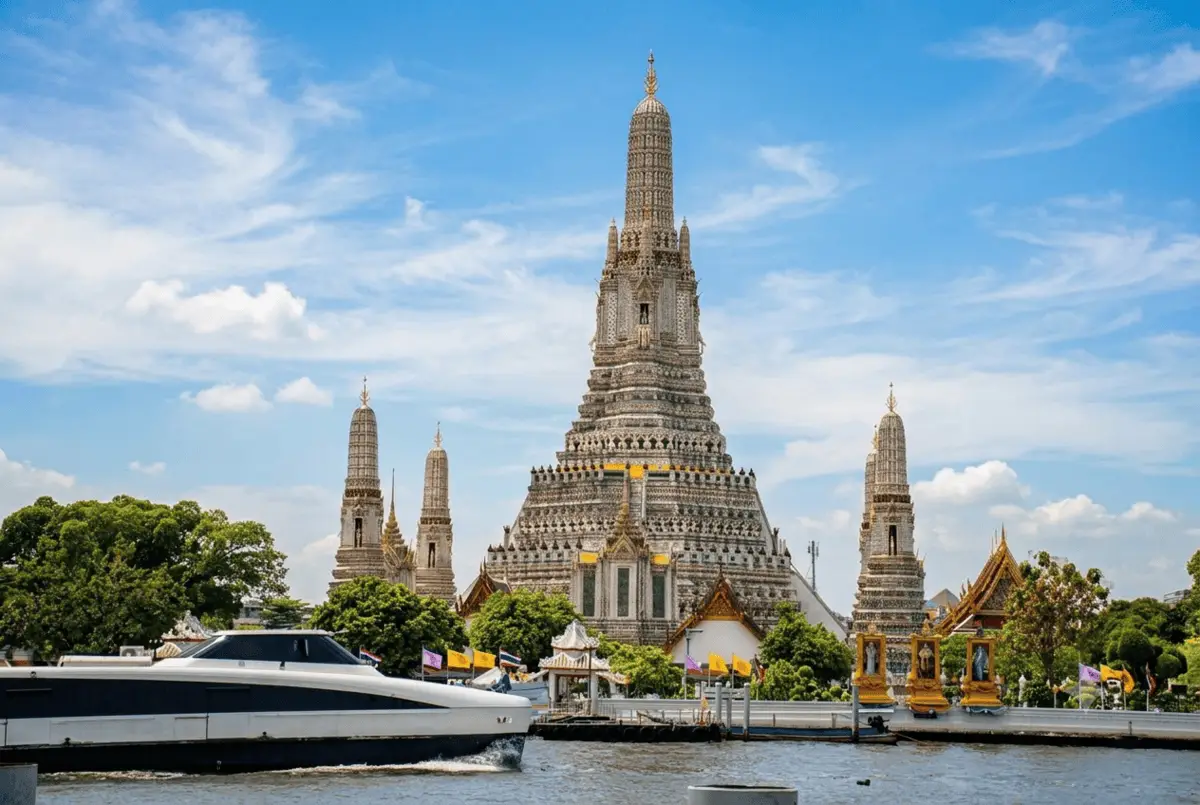
Wat Arun is a functioning royal Buddhist temple on the Thonburi side of the Chao Phraya River, reachable only by a short ferry crossing or a longer road route around the water.
This guide is built for visitors combining the temple with the Grand Palace and Wat Pho circuit. The temple is reachable via a quick cross-river ferry, a road route, or directly via the underground MRT Blue Line tunnel crossing under the river to Itsaraphap Station.
The visit involves a two-stage journey: a river crossing followed by an open-air complex with steep central steps, uneven porcelain-tiled surfaces, and no permanent shade over most of the courtyard. Crowding builds from mid-morning as tour groups arrive by coach, and the site offers minimal indoor refuge from heat, so timing the visit around these two variables matters more than researching temple history.
🗓️ Planning The Visit
- Best season: November through February brings the lowest humidity and clearer river-crossing conditions; April and May bring peak heat above 35°C with little shade on-site.
- Best time of day: Morning arrival (08:00–09:30) beats the tour-coach surge that begins around 10:00; late afternoon (16:00–17:30) offers cooler air and backlighting on the central prang.
- Average visit duration: 45–60 minutes covers the main prang’s courtyard, the four corner satellite towers, and photo positions surrounding the base.
- Peak crowd periods: Weekends and Thai public holidays draw domestic visitors alongside the usual tour groups, doubling wait times at the ferry pier and ticket counter.
- Weather considerations: The complex has almost no covered walkway between the pier and the prang, so rain means a fully exposed walk; bring a compact umbrella rather than relying on shelter.
- Advance booking recommendations: None apply — there is no reservation system for individual visitors, so planning centers on arrival timing rather than booking windows.
💡 Tip: Pairing Wat Arun with Wat Pho in one afternoon works only if Wat Pho is visited first, since the ferry queue from Tha Tien grows longer after 15:00 as day-trippers head back before dark.
📍 How To Get To Wat Arun
Reaching Wat Arun always ends with a river crossing or a road loop, regardless of the starting point.
✈️ By Air
Suvarnabhumi Airport (BKK) and Don Mueang Airport (DMK) both serve Bangkok; neither sits near the temple, so onward travel means a taxi, ride-hailing app, or the airport rail link into the city center followed by a river crossing.
- Suvarnabhumi Airport (BKK) to Wat Arun: Travelers should take the Airport Rail Link (ARL) to Makkasan Station, transfer to the MRT Blue Line (at Phetchaburi Station), and ride to Itsaraphap or Sanam Chai stations.
- Don Mueang (DMK) to Wat Arun: Travelers take the SRT Red Line to Krung Thep Aphiwat (Bang Sue) Grand Station, then transfer to the MRT Blue Line.
⚠️ Warning: Unmetered taxi drivers at both airports frequently quote flat fares well above the metered rate for this route; insist on the meter or use a ride-hailing app instead.
🚇 By Train
Bangkok’s BTS Skytrain does not cross the river to Wat Arun directly. The nearest useful station is Saphan Taksin (Silom Line), which connects to the Chao Phraya Express Boat network.
- From Saphan Taksin BTS: exit toward Sathorn Pier (Central Pier), then board an Orange-flag Express Boat directly to Wat Arun Pier.
- ourney from Sathorn Pier to Wat Arun: ~20–30 minutes depending on the number of stops. Do not get off at Tha Tien Pier, as that is on the opposite side of the river.
- Sanam Chai MRT Station is located on the Phra Nakhon side and is only a 5–7 minute walk (about 400–500 meters) from Exit 1 to Tha Tien Pier, where visitors catch the cross-river ferry.
- Itsaraphap MRT Station, located on the Thonburi side, is a 10–15 minute walk directly to Wat Arun’s roadside entrance, allowing visitors to bypass the river crossing entirely.
🛣️ By Road
Taxi, ride-hailing app, or private car reaches Wat Arun via the Thonburi side road network, bypassing the ferry entirely.
- Typical travel time from central Bangkok hotels: 20–40 minutes outside rush hour, 45–70 minutes during it.
- Ride-hailing apps operate normally in this district; confirm the drop-off point is the temple’s road-side entrance, not the river pier.
📝 Note: Traffic through the old-town streets near the temple is congested and one-way in sections, so drivers often add 10–15 minutes beyond map estimates.
Local Transport, Parking, and the Final Stretch
- For visitors combining their trip with Wat Pho or the Grand Palace on the opposite bank, the final approach is the cross-river ferry from Tha Tien Pier (N8), a crossing of under five minutes.
- Ferry fare per person is only one-way, cash only, paid at the ticket booth before boarding.
- Ferry operating hours run roughly 05:00 to 19:00, later than the temple’s own 18:00 closing time.
- Public bus routes 1, 25, 47, 53, 82, and 508 stop near Maharat Road on the opposite bank near Tha Tien Pier.
- Limited street parking exists near the temple’s land-side entrance for those arriving by road; no dedicated visitor parking structure is published.
- From the Wat Arun ferry landing, it is a 2–3 minute walk to the ticket counter and main gate.
💡 Tip: The cross-river ferry between Wat Arun and Tha Tien continues operating well past the temple’s 18:00 closing time (typically until 20:00 or 21:00 in both directions). Visitors staying on the temple side to photograph the grounds at twilight do not need to worry about being stranded and can easily catch a ferry back across the river after dark.
➡️ Entry Process
Wat Arun has a single public visitor entrance near the ferry landing on the river side, with the ticket counter positioned immediately before the gate. Visitors arriving by road use a separate street-side gate that funnels to the same ticket point.
- Gate choice: river-side entrance is standard for ferry arrivals; road-side entrance suits taxi and ride-hailing drop-offs.
- Ticket verification happens at a manual checkpoint immediately past the counter; no digital scanning is used for individual tickets.
- No ID is required to purchase or use the entry ticket.
- Security screening is minimal — a visual bag check rather than a metal detector or X-ray line.
- Queue length depends heavily on arrival time; expect under 10 minutes before 09:00, and 20–30 minutes during peak coach arrivals (10:00–14:00).
- Re-entry on the same ticket the same day is not formally published; visitors planning to leave and return should retain the ticket stub and ask staff directly.
📝 Note: Official sarong loans are no longer offered on-site. Visitors wearing sleeveless shirts or short skirts/shorts must purchase a sarong or lightweight trousers (around 100–150 THB) from vendors outside the gate before entering the ticket line.”
🎫 Tickets & Booking
Wat Arun uses a single flat-rate structure for foreign visitors rather than the multi-tier pricing seen at some other Bangkok sites.
| Tier | Price | Notes |
|---|---|---|
| Foreign Tourist Tier | 200 THB | Standard adult foreign-visitor rate; typically includes a bottle of water |
| Domestic Tier (Thai nationals) | Free | Thai ID or equivalent proof of nationality may be requested |
| Child/Student Concession Tier | No fixed published rate | Young children are generally admitted free at staff discretion; no published height or age cutoff exists |
Tickets are sold exclusively at the on-site counter; there is no official online booking portal for individual visitors. Payment is accepted in Thai baht cash at the counter; card acceptance is not consistently published, so carrying cash is the reliable option.
- No advance reservation exists or is needed for individual entry.
- Group tours typically arrange entry through their operator rather than the individual counter.
💡 Tip: The 200 THB fee typically includes a small bottle of drinking water, which offsets some of the ticket cost given the lack of shade on-site.
Night Viewing Of Wat Arun
Wat Arun’s grounds close to visitors at 18:00 and do not offer paid night-viewing access to the interior. The central prang is floodlit after dark and remains visible from the exterior, most commonly photographed from the opposite riverbank near Tha Tien rather than from inside the complex.
📋 Visitor Guidelines
- Dress code: Shoulders and knees must be covered for all visitors regardless of gender.
- Photography/videography rules: Personal photography and video are permitted throughout the outdoor complex without an extra camera fee; tripods and commercial shoots may require separate permission from temple staff.
- Allowed/Prohibited items (strict list):
- ✅ Allowed: Personal cameras and phones
- ✅ Allowed: Small personal bags
- ✅ Allowed: Drinking water in a personal bottle
- ❌ Prohibited: Drones without prior temple authorization
- ❌ Prohibited: Loud speakers or amplified audio equipment
- ❌ Prohibited: Smoking anywhere within the temple grounds
- Bag policies: No formal bag-size restriction is published; large backpacks may be asked to be carried in front through narrow stair sections for safety.
- Food & drink rules: Eating is not permitted within the temple courtyard; drinking water is generally tolerated given the heat exposure.
- Expected behavior: Feet should not be pointed toward Buddha images when seated; voices should stay low near active prayer areas.
- Special restrictions / guides & photographers: Independent local guides can be hired near the entrance; commercial or professional photography sessions may require a separate arrangement with temple administration in advance.
⚠️ Warning: Staff at the gate actively turn away visitors in sleeveless tops or above-knee shorts rather than issuing a warning.
♿ Accessibility & Visitor Facilities
| Facility | Status |
|---|---|
| Wheelchair access | ❌ Limited; the central prang’s steep steps are not wheelchair accessible, though ground-level courtyard areas are navigable |
| Navigability for elderly visitors and children | ❌ Uneven porcelain tiling and steep stairs make the main tower difficult for limited-mobility visitors |
| Toilets | ✅ Public restrooms available on-site near the entrance |
| Drinking water availability | ✅ Bottled water sold near the entrance; often included with the entry ticket |
| Cloakrooms/lockers | ❌ No dedicated cloakroom or locker facility is published |
| Seating | ✅ Limited shaded seating near the courtyard perimeter |
| First aid | ❌ No dedicated on-site first aid station is publicly listed |
| Parking | ✅ Limited street-side parking near the road entrance |
👣 During The Visit
- Right after security: Visitors pass the ticket counter directly into the main courtyard facing the central prang. The path is flat here, making it the easiest stretch for anyone with mobility concerns before the steeper sections begin.
- Visitor flow through the site: Most visitors move in a loop from the courtyard entrance to the base of the central prang, around the four satellite towers, then back toward the ferry landing or road exit. The loop is not one-directional or staff-managed.
- Priority areas: The base of the central prang and surrounding courtyard offer the best photo spots. Visitors are welcome to climb the steep staircases to the lower terraces of the central prang for closer views of the porcelain details and the river.
- Known bottlenecks: The staircase to the prang’s lower terrace narrows to single-file in sections, creating a two-way queue during peak hours. The ticket counter itself backs up between 10:00 and 14:00 when coach groups disembark in clusters.
- Where to spend the most time: The base-level detail on the central prang, where porcelain shards and carved figures are closest to eye level, rewards more time than the crowded upper terrace itself.
- Practical movement tips: Climbing the central prang’s steps requires sturdy, closed-toe footwear, since the risers are steep, narrow, and can be slick after rain. Visitors carrying loose items should secure them before climbing, given minimal railing on some sections.
🔖 Things Worth Knowing
- The road-side entrance sees shorter queues than the ferry-side entrance during the 10:00–14:00 coach rush, since most tour groups arrive by boat.
- Wat Arun has no weekly closure day; its only irregular closures are for occasional royal or religious ceremonies announced with little public notice.
- Flying drones is strictly prohibited under national aviation laws. On-site temple staff do not have the authority to grant ad-hoc or case-by-case flight permissions, and attempting to fly one without official and military clearance can result in severe penalties.
- The Tha Tien ferry crossing runs later into the evening than the temple’s own closing time, so visitors can use the same pier for sunset photography from the opposite bank without needing to re-enter the grounds.
- Thai Smile Boat’s electric City Line also stops at Wat Arun Pier, an alternative to the Chao Phraya Express Boat for visitors coming from further downriver.
🔗 Official Resources
- Official Website: tourismthailand.org
- Ticket Reservations: Not applicable; tickets are sold on-site only
- Visitor Information: Tourism Authority of Thailand attraction listing (linked above)
ℹ️ Disclaimer
Operational details such as opening hours, entry fees, transit fares, and dress-code enforcement are subject to change without extensive public notice. Travelers should verify time-sensitive details through official sources shortly before departure to confirm current accuracy.