Fushimi Inari-Taisha: All Essential Information on Opening Hours, Entry Rules and Useful Tips
👀 At a Glance
| 📍 | Destination: Shinto shrine in Kyoto |
| 📌 | Location: Fushimi Ward, southern Kyoto, Japan |
| 🏛️ | Recognition: Spiritual Landmark; Head shrine of over 30,000 Inari shrines nationwide |
| ⏱️ | Visit duration: 45 minutes to 3 hours, depending on hiking distance |
| 🕒 | Opening hours: 24 hours daily, all year |
| 📅 | Weekly closure: None; The shrine grounds are generally accessible 24 hours. Temporary access restrictions or closures may occur for weather, festivals, maintenance or other operational reasons. |
| 🎟️ | Reservation required: Not applicable |
| 💴 | Entry fee: Free for all visitors and tourists. |
| 🌤️ | Best visiting time: Before 7:00 AM for the quietest conditions on the lower torii paths. |
| 🌐 | Official website: Fushimi Inari Taisha Official Page |
📖 Overview
Fushimi Inari-taisha is a Shinto shrine complex spread across a working mountainside, not a single building with a ticket desk. The site functions as both an active place of worship and a 4-kilometer trail network lined with vermilion torii gates. Visitors move through the grounds continuously rather than pausing at a checkpoint, since there is no admission process to complete.
This Fushimi Inari visitor guide targets travelers who need execution details, not shrine history: which train door to exit from, where the queue actually forms, which toilets exist at which elevation, and when the crowd density becomes unmanageable. Generic Kyoto itineraries treat this stop as a 20-minute photo detour. In practice it rewards or punishes travelers based on arrival timing alone.
Visitors should expect a layered experience: near-total congestion in the lower gate tunnels during midday, thinning crowds within 15 minutes of uphill walking, and a genuinely quiet upper mountain after the Yotsutsuji junction. The physical demands are real — uneven stone steps, no elevator, and limited amenities above the halfway point.
🗓️ Planning The Visit
- Best season: Spring (March–April) and autumn (November) draw the largest crowds at the Fushimi Inari Shrine, as cherry blossoms bloom around the lower shrine precinct and vibrant autumn foliage frames the Mount Inari hiking trails.
- Best time of day: Arrival before 7:00 AM allows photography of the lower Senbon Torii tunnel without crowd interference. Congestion builds sharply after 9:00 AM and peaks between 11:00 AM and 3:00 PM.
- Average visit duration: A lower-loop visit covering the Senbon Torii and Okusha prayer area takes 30–45 minutes round trip. Reaching the Yotsutsuji viewpoint adds 1.5–2 hours. The full summit loop runs 2.5–3 hours.
- Peak crowd periods: Weekend late mornings during spring and autumn produce the densest conditions, with shoulder-to-shoulder movement through the first gate tunnel. Weekday early mornings remain comparatively open even in peak season.
- Weather considerations: The trail surface includes gravel and uneven stone, becoming slippery after rain. Summer heat is intensified by limited shade in the lower gate sections; the upper mountain runs several degrees cooler than central Kyoto.
- Advance booking recommendations: None apply, since the shrine has no ticketing system. Travelers planning a guided hike should book that separately, as available slots for early-morning guided walks fill during peak season.
📍 How To Get To Fushimi Inari-Taisha
✈️ By Air
Kansai International Airport (KIX) is the primary international gateway. From KIX, travelers take the JR Haruka limited express directly to Kyoto Station, a journey of roughly 75 minutes. Osaka Itami Airport, used mainly for domestic flights, connects to Kyoto Station via airport limousine bus in approximately 55 minutes.
🚇 By Train
JR Inari Station is located directly opposite the shrine’s main entrance. From Kyoto Station, take a JR Nara Line Local train (about 5 minutes / 2 stops). The Keihan Main Line offers an alternative via Fushimi-Inari Station and is about a 5-minute walk from the shrine. Check the current Keihan timetable for the specific service you board.
📝 Note: Miyakoji Rapid and Express trains do not stop at Inari Station.
🛣️ By Road
Drivers reach the shrine in approximately 20 minutes from the Kyoto Minami Interchange on the Meishin Expressway, or roughly 10 minutes from the Hanshin Expressway’s Kamitoba exit.
⚠️ Warning: The official parking lot is strictly intended for worshippers and formal shrine ceremony attendees, not general tourist sightseers. Public transportation is strongly advised, as parking is extremely limited and frequently closed during peak seasons.
Local Transport, Parking, and the Final Stretch
- JR Inari Station exit places visitors directly at the shrine’s main torii gate — no further walking required.
- Keihan Fushimi-Inari Station requires a ~5–7 minute walk east, crossing the JR tracks, to reach the entrance.
- City bus option: Minami 5 line stops at Inari Taisha-mae, a 7-minute walk to the shrine.
- On-site parking is strictly reserved for worshippers/ceremony attendees; general sightseers are required to use public transport or off-site coin parking.
- Public transport is the officially recommended method, since parking availability cannot be guaranteed.
➡️ Entry Process
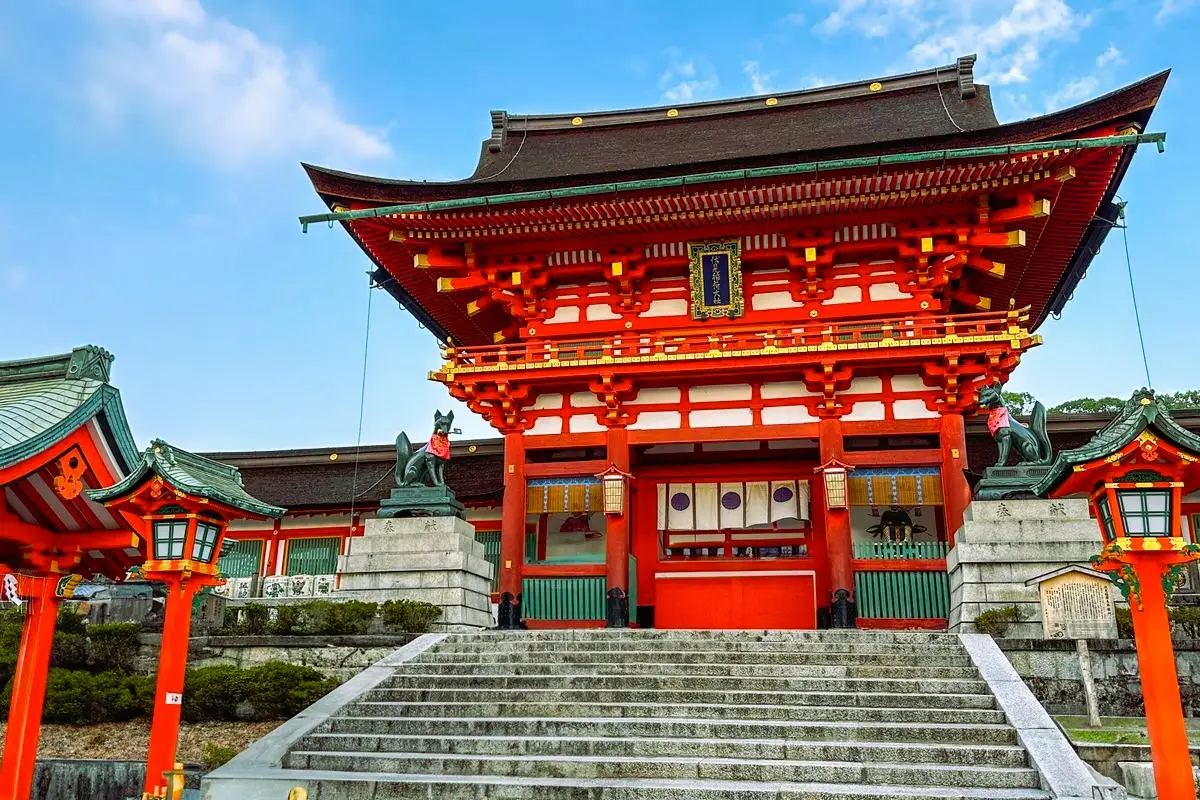
There is no gate, ticket booth, or ID check at the shrine entrance. Visitors walk directly from the station platform toward the large red torii gate marking the main approach, then continue past the Romon Gate into the shrine precinct.
- No security screening applies anywhere on the grounds.
- No re-entry restriction exists, since there is no entry point to log against.
- Queueing occurs only at the physical bottleneck of the first torii tunnel during peak hours, not at any administrative checkpoint.
- Visitors intending to pray at the main hall follow standard shrine etiquette: bow, offer a coin, and clap per posted instructions near the offering box.
📝 Note: The absence of an entry process means crowd density is the only real “gate” travelers negotiate — timing substitutes for a queue-management system.
🎫 Tickets & Booking
No ticket exists for general shrine access at any tier.
| Fee Tier | Price |
|---|---|
| Foreign Tourist Tier | Free |
| Domestic Tier | Free |
| Child/Student Concession Tier | Free |
- Booking is not applicable, since no reservation system covers general entry.
- Optional monetary offerings at the main hall or sub-shrines are voluntary and typically made via coin donation box.
- All monetary offerings (saisen), charm purchases (omamori), and fortune slips require cash in Japanese Yen (JPY). Digital or QR code payments are not accepted at shrine counters or offering boxes.
- Travelers wanting a name-inscribed torii gate donation should inquire directly through the shrine office, as this is a separate paid arrangement outside standard visiting.
- Third-party guided hikes are bookable in advance through independent tour operators; these are optional add-ons, not required for entry.
Night Viewing Of Fushimi Inari-Taisha
Night viewing exists by default, since the shrine imposes no closing time. Pathway lanterns remain lit after dark, and the lower gate tunnels stay accessible. Staffed areas — the shrine office and shops — close around 5:00 PM, so no assistance or purchases are available on-site overnight. Security cameras operate throughout the grounds.
💡 Tip: The upper mountain sections beyond Yotsutsuji have minimal lighting after dark; travelers hiking past this point at night should carry a personal light source.
📋 Visitor Guidelines
- Dress code: No formally enforced code exists, though the shrine requests modest attire suited to an active place of worship.
- ✅ Sleeved tops and knee-length or longer bottoms recommended
- ❌ Wedding dresses or costume-style clothing prohibited on shrine grounds
- Photography/videography rules: Standard photography is permitted throughout most areas.
- ❌ Drone photography prohibited across the entire precinct
- ❌ Photography prohibited in specifically marked restricted zones
- Allowed/Prohibited items (strict list):
- ✅ Allowed: Personal handheld cameras and smartphones throughout general areas.
- ❌ Prohibited: Tripods and monopods along narrow mountain paths and inside the Senbon Torii tunnels.
- ✅ Allowed: Small food and drink for consumption in marked rest areas
- ❌ Prohibited: Entry into the Main Hall, other shrine buildings, or areas beyond the boundary fences
- ❌ Prohibited: Eating or drinking while walking, or outside marked rest areas
- ❌ Prohibited: Discarding litter, bottles, or cans on shrine grounds
- ❌ Prohibited: Selfie sticks in several densely trafficked sections
- Bag policies: No bag checks or size restrictions apply anywhere on-site.
- Food & drink rules: Consumption is restricted to marked free-rest areas only; walking while eating is treated as a violation of shrine conduct.
- Expected behavior: Visitors are expected to keep noise low near prayer areas, walk on path edges rather than center lines to leave room for worshippers, and avoid climbing on torii gates or fox statues.
- Special restrictions / guides & photographers: Independent guides operate without special shrine authorization; professional or commercial filming setups should confirm permissions separately, as these fall outside casual photography allowances.
♿ Accessibility & Visitor Facilities
| Facility | Status |
|---|---|
| Wheelchair access | ✅ Main approach level; stepped section at main hall only |
| Toilets | ✅ Present at lower and mid-mountain points |
| Drinking water | ✅ Vending machines along lower and mid trail |
| Cloakrooms/lockers | ❌ None on shrine grounds; available at both train stations |
| Seating | ✅ Benches at Yotsutsuji and select rest points |
| First aid | ❌ No dedicated on-site medical station |
| Parking | ✅ On-site lot reserved for worshippers only and not for tourists |
- Wheelchair access: The path from the main gate to the shrine buildings is level and navigable. A stepped section leads to the main hall itself, though ramps serve two adjacent side paths.
- Navigability for elderly visitors and children: The lower loop suits most mobility levels; the upper trail involves sustained stone steps and uneven surfaces unsuitable for wheelchairs or strollers past the first quarter-mile.
- Toilets: Facilities exist at the base and partway up the ascent, though condition and maintenance vary by report.
- Drinking water availability: Vending machines are positioned at intervals through the lower and middle trail sections; availability drops in the upper forest stretches.
- Cloakrooms/lockers: Coin lockers are not provided within the shrine grounds; both JR Inari and Keihan Fushimi-Inari stations have locker banks nearby.
- Seating: Benches and rest areas cluster at the Yotsutsuji intersection, roughly the trail’s midpoint.
- First aid: No staffed medical point exists on the mountain; visitors with medical needs should plan around this gap in advance.
- Parking: On-site lots serve worshippers exclusively and reach capacity on weekends; staff direct overflow traffic to alternate locations when full.
📝 Note: The official worshipper parking lot closes overnight from 10:00 PM to 5:00 AM.
👣 During The Visit
Visitors exit the station directly onto the shrine’s main approach, with the large red torii and Romon Gate visible immediately. From here, foot traffic splits: most visitors turn toward the main hall first, then proceed to the Senbon Torii tunnel behind it.
- The Senbon Torii tunnel is the primary bottleneck; expect single-file shuffling during midday hours.
- A one-way flow pattern operates on sections of the main torii path during the 10:00 AM–3:00 PM peak window to manage foot traffic direction.
- Past the Okusha prayer area, gate density thins and walking space opens noticeably within 10–15 minutes.
- Side paths branching right shortly after the first tunnel lead to a bamboo forest and smaller sub-shrines, consistently less congested than the main route.
- Yotsutsuji intersection marks the practical turnaround point for time-limited visitors, offering the main panoramic view over Kyoto.
- Beyond Yotsutsuji, foot traffic drops sharply; this section suits visitors seeking solitude over photo density.
- The stepped section to the main hall interior is the one point where the level accessible path does not continue — plan around this if pushing a stroller or wheelchair.
🔖 Things Worth Knowing
- The bamboo-forest side path branching right just past the first tunnel entrance stays quiet even at midday, unlike the main route.
- Toilets thin out significantly above the Yotsutsuji junction; using facilities at the base before climbing further is advisable.
- Wild boar sightings have been reported on upper trail sections after dark; travelers hiking at night should stay alert on unlit stretches.
- The shrine’s shops and staffed office close around 5:00 PM daily, even though the grounds themselves never close — no purchases or staff assistance are available overnight.
- Weekday mornings remain markedly less crowded than weekend mornings even during peak cherry blossom or autumn foliage season.
- Most visitors turn back after the Senbon Torii tunnel and never see the quieter upper mountain, so route choice alone controls crowd exposure more than timing does.
🔗 Official Resources
- Official Website: Fushimi Inari Taisha Official Page
- Ticket Reservations: Not applicable; the shrine has no ticketed entry system.
- Visitor Information: Access – Fushimi Inari Taisha
ℹ️ Disclaimer
Operational details such as opening patterns, transit schedules, facility locations, and posted rules may change without notice. Travelers should verify time-sensitive specifics through official shrine and transit sources before departure.