Machu Picchu Visitor Guide: Circuits, Tickets, Rules & Critical Mistakes
At a Glance ⭐
- Destination: Historic Sanctuary and Inca citadel
- Location: Urubamba Province, Cusco Region, Peru
- Recognition: UNESCO World Heritage Site; New7Wonders of the World
- Visit duration: Standard circuits are strictly capped at 2 to 2.5 hours; mountain add-on routes allow 4 to 7 hours.
- Opening hours: 06:00 to 17:30 daily, last entry approximately 15:00
- Weekly closure: None — open every day of the year, including public holidays
- Entry fee: Tiered by nationality and circuit (Foreign Tourist Tier, Peru/Andean Community Tier, Student/Minor Concession Tier)
- Best visiting time: Dry season, early morning entry slot
- Official website: machupicchu.gob.pe (general info) & tuboleto.cultura.pe (government booking portal)
Overview
Machu Picchu is a fixed-capacity archaeological site with a mandatory timed-entry system, a single approach route, and no road access. Every visit requires a pre-booked ticket, a specific entry window, and a specific circuit. However, free movement through the ruins is prohibited.
This Machu Picchu Visitor Guide is built for travelers planning the physical execution of a visit: booking sequence, transit connections, gate procedures, and on-site rules. It skips historical background and focuses on what determines whether a visitor gets through the gate on schedule.
Expect a multi-stage journey. Reaching the site means coordinating road or rail transport to a base town, a rail or trek segment with no vehicle alternative, a shuttle or climb to the entrance, and a ticket-verification checkpoint that checks passport and QR code together. Each stage has its own booking window and its own failure points.
Planning The Visit
- Best season: May through September (dry season) offers the clearest skies and lowest rain risk. Trails are less slippery and photography conditions are more consistent.
- Best time of day: The 06:00–07:00 entry slot has thinner crowds and cooler temperatures before midday cloud buildup. Afternoon slots after 12:00 face tour-group overlap from same-day arrivals.
- Average visit duration: Standard tickets (Circuit 1 and Circuit 2) limit your visit to 2.5 hours. If you book a mountain add-on ticket then allowed time increases to 6 hours total for Huayna Picchu or 7 hours total for Machu Picchu Mountain.
- Peak crowd periods: June through August sees the heaviest volume, driven by Northern Hemisphere summer holidays. Late December through early January also spikes around New Year travel.
- Weather considerations: November through March is rainy season. Rain does not close the site, but it increases stone-path slip risk and reduces visibility on upper circuits.
- Advance booking recommendations: Entry tickets for popular circuits, especially Huayna Picchu, often sell out weeks to months ahead in dry season. Train seats on early-morning departures sell out on a similar timeline. Booking entry tickets before train tickets avoids mismatched schedules.
How To Get To Machu Picchu
There is no direct road to Machu Picchu itself. Every route funnels through Aguas Calientes, the base town at the foot of the mountain, reachable only by rail or on foot.
By Air
The nearest airport is Alejandro Velasco Astete International Airport (CUZ) in Cusco, served by domestic connections from Lima and select international routes. From Cusco, onward travel to the rail departure point takes an additional 1.5 to 2 hours by road.
By Train
Two operators run the Cusco/Sacred Valley–to–Aguas Calientes line: PeruRail and Inca Rail. Trains depart from Ollantaytambo (roughly 1 hour 45 minutes to Aguas Calientes) or from Cusco stations using a bimodal bus-plus-train service (roughly 3.5 hours total). Ollantaytambo carries the highest frequency and is the standard boarding point for most travelers. No walk-up rail tickets should be assumed available in high season — book online in advance through the operator’s official site.
By Road
Independent budget travelers can reach Hidroeléctrica by road via Santa María and Santa Teresa, then either walk roughly 2 hours along the rail corridor or take a short local train into Aguas Calientes. Walking directly on the tracks from Ollantaytambo is prohibited for safety reasons.
Local Transport, Parking, and the Final Stretch
- No private vehicles reach the citadel entrance.
- From Aguas Calientes, the official Consettur shuttle covers the ~25–30 minute ascent to the gate.
- Shuttle departures begin around 05:30 with frequent runs through the morning.
- Walking the ascent on foot is possible via a signed trail, typically 1.5 to 2 hours uphill.
- No general parking exists at the entrance.
- The shuttle and the walking trail are the only approach options.
Entry Process
- A single main entrance building serves all circuits, located next to the shuttle drop-off point.
- Ticket QR codes are scanned at the checkpoint.
- Passport or national ID (for Peruvian/CAN citizens) is scanned alongside it.
- The name on the ticket must match the ID presented exactly, or entry is refused.
- Visitors should arrive at least 15–20 minutes before their assigned entry time.
- Entry outside the assigned time window is not guaranteed.
- Late arrivals may be denied outright.
- Bag and security screening happens at the entrance building before the turnstile.
- Circuit and Route assignments are fixed at booking (there are 3 Main Circuits divided into 10 sub-routes) and switching routes after entry is impossible.
📌 Note: Gate staff enforce a strict 30-minute grace period based on your ticket’s printed time. If your ticket is for 08:00, you have exactly until 08:30 to scan in. Arriving at 08:31 means your ticket is void and entry will be denied.
⚠️ Warning: Re-entry is not permitted under any circumstance short of a declared emergency. Once a visitor exits through the main gate, that ticket is closed for the day.
Tickets & Booking
Booking Tickets Online or at the Gate
Tickets are sold through the official Ministry of Culture portal at tuboleto.cultura.pe, the government’s authorized ticketing platform for archaeological sites across Peru. Reselling agencies exist and are common in Cusco, but pricing runs above face value and reliability varies — the official portal remains the only source that guarantees ticket validity at face value.
| Tier | Applies To | Typical Inclusion |
|---|---|---|
| Foreign Tourist Tier | Non-Peruvian, non-CAN passport holders | Standard circuit access |
| Peru / Andean Community Tier | Peruvian nationals and citizens of Bolivia, Ecuador, Colombia | Discounted circuit access |
| Student / Minor Concession Tier | Verified students under 25 and minors, within either nationality group | Further-reduced circuit access |
- Online booking is the default and recommended path.
- At-gate purchase is not reliable, due to a dynamic daily capacity:
- 4,500 visitors per day during the regular season.
- 5,600 visitors per day during the high season (June–October and late December).
- Reservations typically hold for a limited window of around 3 hours before automatic cancellation if unpaid.
- The official portal accepts major international credit cards and debit cards.
- Ticket changes after purchase are generally not permitted.
- Date or time errors require full cancellation and corrected date or time requires a fresh booking.
- Mountain add-ons are separate ticket categories bundled with citadel entry.
- Mountain add-ons are typically the first tickets to sell out.
Night Viewing Of Machu Picchu
No night viewing exists at the site. Operations run within fixed daylight hours only, and no after-dark or illuminated-tour program is offered by the site administration.
Visitor Guidelines
- Dress code:
- ✅ Comfortable walking shoes with closed toes recommended
- ❌ High heels or hard-soled dress shoes discouraged for stone-path safety
- Photography/videography rules:
- ✅ Handheld personal photography and video permitted
- ❌ Tripods, monopods, selfie sticks, and camera stabilizers prohibited without prior Ministry authorization
- ❌ Commercial or promotional filming without authorization prohibited
- Allowed/Prohibited items (strict list):
- ✅ Allowed: Small backpacks or bags (maximum 40 x 35 x 20 cm)
- ✅ Allowed: Water in a personal, reusable canteen or flask (non-glass)
- ✅ Allowed: Rubber-tipped canes for visitors with mobility needs
- ❌ Prohibited: Single-use plastic water bottles
- ❌ Prohibited: Thermoses or insulated metal flasks (classified as banned kitchenware)
- ❌ Prohibited: Any food or snacks past the entrance turnstiles
- ❌ Prohibited: Tripods, monopods, and selfie sticks
- ❌ Prohibited: Drones or any aerial equipment
- ❌ Prohibited: Umbrellas (wear a rain poncho instead)
- ❌ Prohibited: Alcohol and illegal substances
- ❌ Prohibited: Metal-tipped walking sticks or trekking poles inside the citadel
- ❌ Prohibited: Strollers and prams
- Bag policies: Bags exceeding the maximum dimension must be checked at a storage point near the entrance before proceeding to the checkpoint.
- Food & drink rules: Eating is strictly prohibited past the entrance turnstiles. You must finish any snacks before entering the site.
- Expected behavior: Visitors must remain on the marked path for their assigned circuit at all times. Climbing, sitting, or leaning on Inca stonework is prohibited. Running, shouting, and other disruptive conduct can result in expulsion without refund.
- Special restrictions / guides & photographers: Professional camera equipment and any promotional filming require prior written authorization from the Cusco Decentralized Culture Office. Guides must stay with their assigned group for the full circuit and may not exchange visitors between groups.
Accessibility & Visitor Facilities
| Facility | Status |
|---|---|
| Wheelchair access | ❌ Not viable inside the citadel; stone stairways and uneven paths block most circuits |
| Toilets | ❌ None inside the citadel; located only at the entrance building |
| Drinking water | ❌ No refill stations on site; bring a filled bottle |
| Cloakrooms/lockers | ✅ Bag storage available near the entrance for oversized items |
| Seating | ❌ Minimal seating inside the site |
| First aid | ✅ Basic first-aid point at the entrance building |
| Parking | ❌ No vehicle parking at the citadel; shuttle or walking trail only |
- Wheelchair access: A short section of level path near the entrance offers a viewpoint over the site without requiring stairs, but the interior circuits are not wheelchair-passable.
- Navigability for elderly visitors and children: Steep, uneven stone steps appear throughout most routes. Visitors with limited mobility should book Circuit 3 (The Royalty Circuit), which explores the lower ruins and involves significantly less elevation change than the upper panoramic terraces of Circuit 1.
- Toilets: Positioned outside the main gate only, staffed with a small per-use fee collected on site.
- Drinking water availability: No vendors or fountains operate past the entrance checkpoint.
- Cloakrooms/lockers: Storage exists specifically for backpacks exceeding the permitted carry-in size.
- Seating: Limited to a few benches near the entrance; the circuits themselves have essentially none.
- First aid: Staffed during operating hours at the entrance building; no medical post exists deeper in the site.
- Parking: Not applicable — the shuttle drop-off and trailhead are the only vehicle-adjacent points.
💡 Tip: When booking for a family, pay close attention to the route sub-categories. The add-on hikes for Huayna Picchu, Huchuy Picchu, and the Inca Bridge have a strict 12+ age requirement. Families with younger children should stick to the standard Route 2-A (Classic Circuit) or Route 3-B (Lower Ruins).
During The Visit
- Security screening happens right after ticket verification.
- Bag checks happen at the same point, before the turnstile.
- Visitor flow moves in one direction per circuit.
- Backtracking against the flow is generally discouraged.
- Staff sometimes physically block backward movement at junctions.
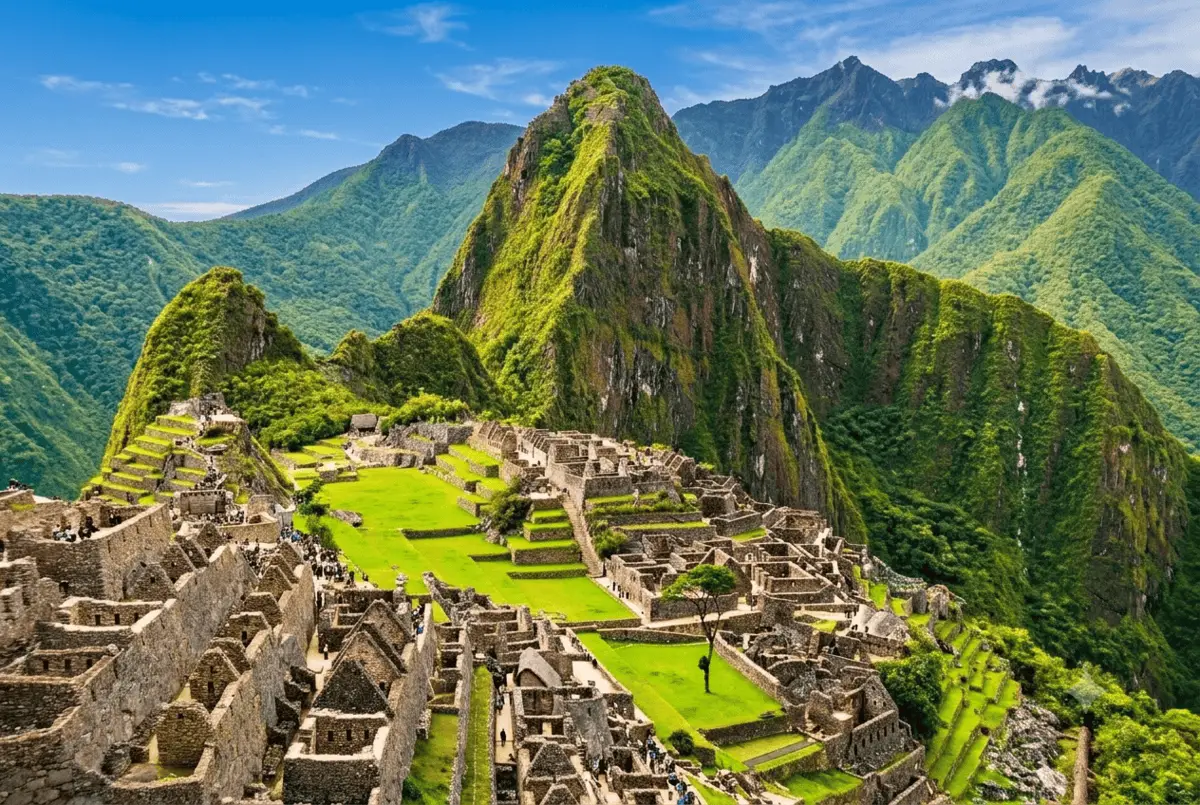
- The entrance-area viewpoint gives the standard postcard photo angle.
- The iconic “postcard” viewpoint is only accessible to visitors holding Circuit 1 (Panoramic) or Circuit 2 (Classic) tickets. Visitors on Circuit 3 will bypass this upper terrace entirely.
- Bottlenecks form at narrow stone stairways.
- The worst congestion hits where upper and lower paths converge.
- That convergence congestion peaks mid-morning.
- Visitors should use the entrance toilets before starting.
- No toilets exist past the checkpoint.
- Re-entry is barred, so a mid-visit bathroom trip is not possible.
- Guided groups typically move at a fixed pace.
- Independent visitors can pause longer at viewpoints.
- Independent visitors must stay within their circuit’s marked route.
- Sun Gate and Inca Bridge extensions add 45–90 minutes each, where ticketed.
- Both extensions involve meaningful additional elevation gain.
Things Worth Knowing
- Circuit 3 (Royalty) sees noticeably lighter foot traffic than Circuit 2. However, it skips the upper terraces that most visitors prioritize for photography.
- Circuit 1 will get you the panoramic views but you will not be allowed to walk through the main urban sectors or temples down below.
- The first Aguas Calientes shuttle of the day fills fast.
- Arriving by 05:00 beats the posted first-departure time.
- Unpaid reservation holds expire automatically and releases the ticket slot back into inventory.
- Refreshing the booking calendar can reveal returned slots during sellouts.
- Light rain can give clearer visibility between showers often beating the haze of peak dry-season midday.
💎 Expert Insight: If you’re eager to cross more legendary landmarks off your bucket list, Mexico’s Chichen Itza is another destination worth considering. Like Machu Picchu, it is both a UNESCO World Heritage Site and one of the New7Wonders of the World. The Chichen Itza Visiting Guide will help you plan the journey with confidence.
Official Resources
- Official website: machupicchu.gob.pe
- Official booking page: tuboleto.cultura.pe
- Official visitor information: Ministry of Culture of Peru visitor regulations and code of conduct, published on official website mentioned above.
Disclaimer
Operational details such as hours, fees, circuit availability, and booking procedures are subject to change by the Peruvian Ministry of Culture without extended notice. Travelers should verify all time-sensitive details through the official channels listed above before finalizing travel arrangements.