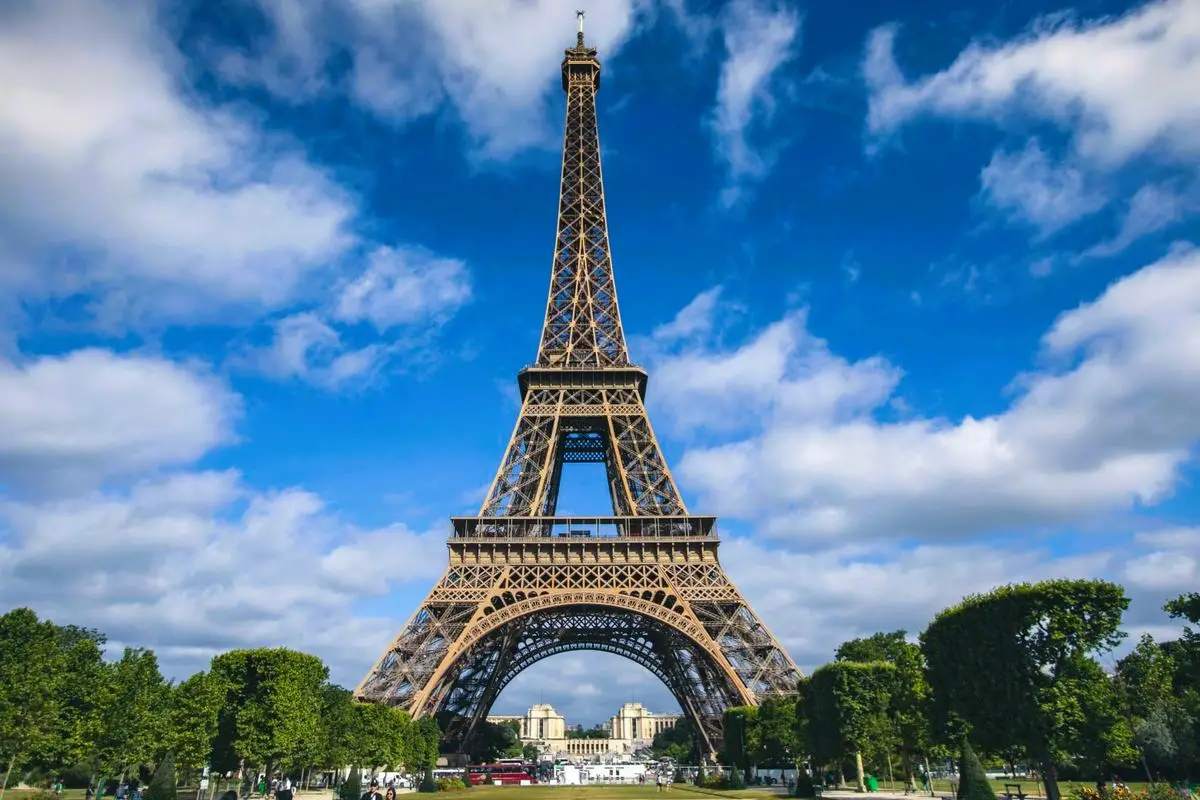
Eiffel Tower Visitor Guide: Entry Rules, Tickets & Common Mistakes to Avoid
👀 At a Glance
| 📍 | Destination: Eiffel Tower, Champ de Mars, Paris, France |
| 📌 | Location: 5 Avenue Anatole France, 75007 Paris (7th arrondissement) |
| 🏛️ | Recognition: UNESCO World Heritage Site (Banks of the Seine inscription) |
| ⏱️ | Visit duration: 2–3 hours including security and queue time |
| 🕒 | Opening hours: 09:30–23:45 (last ascent 22:30); extended summer hours 09:00–00:45 (last ascent 23:00) |
| 📅 | Weekly closure: No fixed weekly closure; the Tower is open daily, but exceptional closures can occur. |
| 🎟️ | Reservation required: Recommended for lift access, mandatory for stairs from Sept 29, 2026 |
| 💶 | Entry fee: €14.80–€36.70 (Foreign/Standard Adult Tier) |
| 🌤️ | Best visiting time: Early morning (09:00–10:00) or late evening (21:00–22:30) |
| 🌐 | Official website: Eiffel Tower website |
📖 Overview
The Eiffel Tower is a multi-level observation structure with three publicly accessible floors, four entry pillars, and a ticketing system that branches by access method (stairs vs. lift) and destination floor (2nd floor vs. summit). This Eiffel Tower visitor guide is built for travelers who need an execution plan, not a description of the ironwork.
Visitors should expect a layered logistics chain: online booking → timed entry slot → pillar-specific queue → security screening → floor-by-floor movement, often with a second queue transfer for summit access. High visitor volume is constant, and the site operates closer to an airport terminal than a static monument. Planning failures here (wrong pillar, missed time slot, oversized bag) cost hours, not minutes.
🗓️ Planning The Visit
- Best season: Spring (April–June) and early autumn (September–October) balance moderate crowds with stable weather; summer months see the highest attendance and longest security lines.
- Best time of day: The first entry slot after opening and the final two hours before closing carry the shortest pillar queues, based on the site’s own attendance data.
- Average visit duration: Average visit duration: Allow at least 1.5 hours for the 1st & 2nd floors and about 2.5 hours for a visit to the summit.
- Peak crowd periods: July and August are the maximum-attendance months; European school holidays can also increase attendance and queues.
- Weather considerations: Summit access can be suspended during high wind or lightning; the 2nd floor remains open in most weather short of severe storms.
- Advance booking recommendations: Lift tickets release 60 days ahead; stair tickets release up to 14 days ahead, but can also be purchased on-site subject to same-day availability.
⚠️ Warning: Third-party sites mimicking the official ticket portal are common. Purchase only through toureiffel.paris or ticket.toureiffel.paris.
📍 Getting There
✈️ By Air
Paris is served by two main international airports: Charles de Gaulle (CDG) and Orly (ORY).
- From CDG: take RER B to Saint-Michel Notre-Dame, transfer to RER C toward Versailles/Pontoise, exit at Champ de Mars–Tour Eiffel. ~60–75 minutes total.
- From Orly: take the Orlyval shuttle to Antony, connect to RER B, then transfer to RER C as above, or take a direct taxi (~30–40 minutes depending on traffic).
- Airport taxis and ride-hail services are available at both terminals; journey cost varies with traffic and time of day.
🚇 By Train
- RER C to Champ de Mars–Tour Eiffel station: closest rail stop, ~5-minute walk to Entrance 1 (Allée des Refuzniks). Step-free with elevator access at the station.
- Metro Line 6 to Bir-Hakeim: under 10-minute walk to Entrance 1; the station has elevators.
- Metro Line 9 to Trocadéro: ~15-minute walk via Pont d’Iéna, delivering the classic front-on tower approach.
- Metro Line 8 to École Militaire: ~15-minute walk through Champ de Mars park to the south side.
🛣️ By Road
- Central Paris traffic is dense; self-driving adds significant unpredictability versus rail.
- Paid public parking garages operate near Quai Branly and Avenue de Suffren; on-street parking near the Tower is limited and metered.
- Reserved disability parking spaces are located on Avenue Joseph Bouvard, 75007 Paris.
- Taxi and private car drop-off points are at the west pillar (Quai Branly, taxis) and east pillar (Quai Branly/Avenue Gustave Eiffel, private cars).
Local Transport, Parking, and the Final Stretch
- Bus lines 42, 30, and 82 stop within a 5-minute walk of Entrance 2 (Allée Jean Paulhan).
- The approach routes from Bir-Hakeim and Champ de Mars–Tour Eiffel are flat, paved walkways, but the route from Trocadéro involves navigating the Chaillot hill via a large set of stairs or side ramps down to the river.
- The RER C route provides the only fully step-free public transit path from station to entrance.
➡️ Entry Process
Two security perimeter entrances serve the site: Entrance 1 (South) and Entrance 2 (East). Once inside the gardens, the four pillars (North, East, West, and South) provide access up the Tower.
- East, West and North pillars provide elevator access and can facilitate access for visitors with reduced mobility. Follow the signs on site to the pillar open for elevator visitors that day. Staff direct visitors to the appropriate accessible entrance.
- South pillar provides the sole entrance for stair-ticket holders; typically the busiest and slowest queue.
💡 Tip: Entering through North, East, or West with a pre-booked lift ticket avoids the South pillar’s stair-queue overflow entirely.
Pass the first security checkpoint at the East or South garden entrance, then follow the line for visitors with tickets to the appropriate pillar, where a second security check takes place before elevator or stair access.
- Valid photo ID is required for all ticket holders as e-tickets are nominative, and is strictly enforced to claim youth, child, or disabled concession rates.
- Security screening (bag check plus metal detector) typically adds 15–20 minutes; this extends during peak season.
- The time shown on the ticket is the scheduled access time; visitors should arrive early enough to complete security checks before that time. Late access is subject to availability in a later time slot.
- Re-entry is not permitted once a visitor exits the paid zone on a single-use ticket.
🎫 Tickets & Booking
| Ticket Type | Adult Tier | Youth Tier (12–24) | Child Tier (4–11) |
|---|---|---|---|
| 2nd Floor — Stairs | €14.80 | €7.40 | €3.80 |
| 2nd Floor — Lift | €23.50 | €11.80 | €6.00 |
| Summit — Stairs + Lift | €28.00 | €14.00 | €7.00 |
| Summit — Lift | €36.70 | €18.40 | €9.20 |
Disabled Tier pricing matches the Child Tier rate across all four categories (€3.80–€9.20 depending on ticket type), and covers one accompanying companion at the same reduced rate. Children under 4 enter free with a mandatory free ticket.
- Booking channels: Online at Official ticket office (timed entry, guaranteed slot) or in person at the on-site ticket office (subject to same-day availability).
- Payment methods: Online bookings accept major credit and debit cards; on-site ticket offices accept both cash and card.
- Group bookings: Groups exceeding nine people, including the guide, must book through the dedicated professional portal (ticketpro.toureiffel.paris) starting September 29, 2026.
- Ticket modification: Most ticket types cannot be exchanged or refunded once purchased.
Night Viewing
The Tower remains open into the evening, with standard closing at 23:45 (last ascent 22:30), extended during summer to 00:45 (last ascent 23:00). Evening slots consistently carry shorter ticket-counter queues than daytime hours, per the site’s own attendance guidance.
📋 Visitor Guidelines
- Dress code: No formal dress code is enforced.
- Photography/videography rules: Personal photography is generally permitted, but visitors must not photograph or film Eiffel Tower staff or professional workers without their express consent, and objects must not be passed through the panoramic safety grilles.
- Allowed/Prohibited items (strict list):
- ✅ Allowed: Plastic or metal water bottles (full or empty)
- ✅ Allowed: Personal cameras and smartphones
- ❌ Prohibited: Packages or luggage exceeding 40cm x 60cm are prohibited.
- ❌ Prohibited: Firearms, knives, and other weapons
- ❌ Prohibited: Glass bottles and alcohol brought from outside
- ❌ Prohibited: Drones (citywide restriction around Paris landmarks)
- ❌ Prohibited: Animals, except assistance animals required by registered disabled visitors.
- Bag policies: All bags are subject to inspection; oversized bags are refused at security with no on-site storage available.
- Food & drink rules: Glass bottles, beverage cans and excessive quantities of food or drink are prohibited; a reasonable quantity of food and drink is allowed at staff discretion.
- Expected behavior: Climbing on railings or structures is forbidden; staff instructions must be followed at all checkpoints.
- Special restrictions / guides & photographers: Professional photography, film shoots, and recording for internet or social-media content require prior written authorization from SETE.
📝 Note: There is no left-luggage facility at the Tower. Oversized bags must be stored offsite before arrival.
♿ Accessibility & Visitor Facilities
| Facility | Status |
|---|---|
| Wheelchair access | ✅ 1st and 2nd floors via lift; summit not accessible |
| Elderly/child navigability | ✅ Flat approach paths; lift priority for reduced mobility |
| Toilets | ✅ Ground floor (behind East pillar), 1st and 2nd floors |
| Drinking water | ✅ Available at kiosks on 1st and 2nd floors |
| Cloakrooms/lockers | ❌ No left-luggage or locker service on-site |
| Seating | ✅ Limited seating at 1st and 2nd floor viewing areas |
| First aid | ✅ On-site medical station staffed during opening hours |
| Parking | ✅ Paid garages nearby; dedicated disabled spaces on Avenue Joseph Bouvard |
⚠️ Warning: The summit is not wheelchair accessible due to a stair transfer before the final lift and emergency evacuation requirements.
👣 During The Visit
After clearing security, visitors reach the base level beneath the Tower, where pillar-specific elevator or stair access begins. The 1st floor holds exhibition space and a glass viewing floor; the 2nd floor holds the primary panoramic viewing platforms and is the endpoint for 2nd-floor tickets.
- Summit-ticket holders transfer to a second elevator queue at the 2nd floor; this transfer is the most common bottleneck of the entire visit.
- Wheelchair users can access the 1st and 2nd floors by elevator, with facilitated access arranged by Eiffel Tower staff.
- Dining and retail are concentrated on the 1st and 2nd floors; visiting these adds meaningfully to total time on-site.
- The busiest physical chokepoint is the 2nd-floor elevator bank feeding the summit lift, particularly between 11:00 and 17:00.
- Visitors prioritizing efficiency should treat the 2nd floor as the primary stop and treat summit access as a distinct, separately queued add-on.
🔖 Things Worth Knowing
- The South pillar is the only stair-accessible entrance; visitors without a stair ticket should avoid this queue entirely.
- A ticket for the 2nd floor cannot be upgraded to summit access after purchase or at the gate — the destination is locked in at booking.
- Evening hours after 21:00 consistently show shorter ticket-counter lines than any daytime window, based on the operator’s published attendance patterns.
- Entrance 2 (East) is often less crowded than Entrance 1 (South); visitors with reduced mobility should follow staff directions for facilitated access.
- Champ de Mars–Tour Eiffel station on RER C is closed from July 15 to August 22, 2026; alternative stations include Bir-Hakeim on Metro Line 6, Trocadéro on Line 9, and École Militaire on Line 8.
🔗 Official Resources
- Official Website: Eiffel Tower website
- Ticket Reservations: Official ticket office
- Visitor Information: Planning Smooth Visit
ℹ️ Disclaimer
Operational details including hours, pricing, closures, and entry procedures are subject to change without notice. Travelers should verify time-sensitive details through official sources before travel.