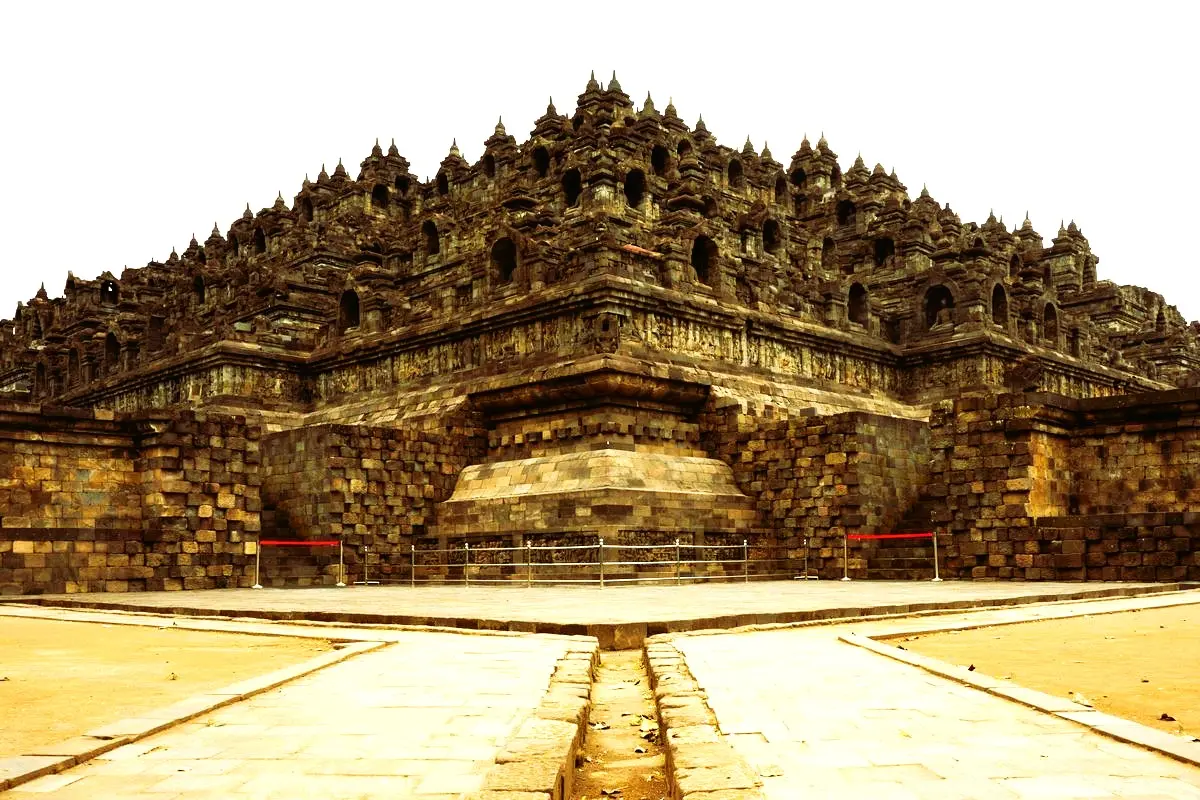
Majestic Borobudur Temple: A Complete Visitor Guide to Indonesia’s Ancient Buddhist Wonder
👀 At a Glance
| 📍 | Destination: A 9th-century Buddhist temple in the Kedu Valley |
| 📌 | Location: Borobudur, Magelang Regency, Central Java, Indonesia |
| 🏛️ | Recognition: UNESCO World Heritage Site |
| ⏱️ | Visit duration: 2 to 3 hours for Temple Grounds and Temple Structure combined |
| 🕒 | Opening hours: Temple Ground: 06:30–16:30 (Only For Domestic Tourist); Temple Structure: 08:30–17:00 |
| 📅 | Weekly closure: None; the site operates seven days a week |
| 🎟️ | Reservation required: Yes, Mandatory for the Temple Structure climb; courtyard access can be purchased without a structure reservation |
| 💵 | Entry fee: IDR 350 (Foreign Tourist – Adult); IDR 305 (Foreign Tourist – Child) |
| 🌤️ | Best visiting time: Weekday mornings, 08:30 session, outside July–August and Indonesian public holidays |
| 🌐 | Official website: Borobudur Temple |
📖 Overview
Borobudur Temple functions as a two-part visitor site: an open park with museums and gardens, and a stepped stone monument that requires a separate, quota-controlled ticket to climb. Visitors choose between Temple Court and Temple Climb tickets; the current visitor flow begins through Borobudur Art Village (KSB), where ticketing is available.
This Borobudur Temple visitor guide targets travelers who intend to climb the structure itself, not just photograph it from the park. That distinction drives almost every logistical decision covered here: which ticket to buy, when to book it, what to wear, and how much walking separates the parking area from the monument.
Visitors should expect a multi-stage entry process. The current standard visitor route starts at Borobudur Art Village (KSB); Manohara is no longer the standard entry/waiting point described by the operator. Grounds-only visitors skip the climb queue but still cover a similar walking distance. Crowd density depends heavily on session time and season, covered in detail below.
🗓️ Planning The Visit
- Best season: The best time to visit Borobudur Temple is May through September due to the lowest rainfall, reducing the chance of a climb session getting cut short by a downpour on the exposed upper terraces.
- Best time of day: The first regular climb session starts at 08:30; early sessions generally avoid the strongest midday heat.
- Average visit duration: Budget 90 minutes for the guided structure session alone, plus 30–60 minutes for grounds, museums, and the exit walk through the market corridor.
- Peak crowd periods: Weekends, Indonesian school holidays, and the days surrounding the Vesak (Waisak) festival draw the heaviest volume and fastest ticket sell-outs.
- Weather considerations: Heavy rain between November and March does not close the site, but sudden downpours force climb groups off the exposed stone terraces mid-session.
- Advance booking recommendations: Book the Structure ticket in advance because daily climbing capacity is limited; weekend/holiday sessions should be booked as early as possible.
📍 Getting There
Reaching Borobudur Temple requires a deliberate transfer from Yogyakarta, since no airport or train station sits within the town itself.
✈️ By Air
Yogyakarta International Airport (YIA) is the primary gateway for visiting Borobudur Temple, located roughly 60 km from Borobudur. DAMRI operates a direct YIA–Borobudur service, but published schedules vary; do not state a fixed two-hourly 08:00–18:00 schedule. Yogyakarta International Airport (YIA) is the relevant current commercial airport gateway.
🚇 By Train
There is no railway to Borobudur. From Yogyakarta’s stations, continue by road; Prambanan Express does not run to Magelang.
🛣️ By Road
Private car or ride-hail is the fastest option from central Yogyakarta, covering the ~40 km distance in about 1 to 1.5 hours outside peak traffic.
- Public buses operate from Yogyakarta/Jombor toward Borobudur.
- A private car charter runs both directions and suits travelers timing a specific climb session.
Local Transport, Parking, and the Final Stretch
Vehicles of all kinds stop at an outer parking zone, separate from the ticket gates. From that zone, visitors walk roughly 500–700 meters through a market corridor to reach the Manohara ticketing and waiting area. An electric buggy service covers this stretch for travelers with mobility limitations. On departure from the temple itself, a free shuttle (Wira Wiri) returns visitors to the main entrance area, cutting the otherwise ~20-minute walk back through the exit path.
➡️ Entry Process
All visitors entering Borobudur Temple pass through a single main gate complex before splitting into grounds or structure queues based on ticket type.
- Grounds-only ticket holders proceed directly through the park entrance after a bag check.
- Structure ticket holders continue to the Manohara waiting area for guide assignment and session check-in.
- Structure visitors receive a wristband, scanned electronically on entry and again on exit from the monument.
- Passport or government ID is required at ticket collection if the reservation was booked online under that name.
- Security screening includes a bag check at the outer gate; large backpacks are directed to the on-site lockers before the climb.
⚠️ Warning: Structure sessions run on fixed hourly departure times. Arriving after a booked slot’s cutoff typically forfeits that reservation, with no automatic transfer to a later session.
Re-entry to the temple structure on the same-day ticket is not standard; the wristband scan logs a single exit. Grounds access, by contrast, allows more casual movement in and out of the park periphery within operating hours.
🎫 Tickets & Booking
| Ticket Type | Price (Indonesian Rupiah) |
|---|---|
| Foreign Tourist – Adult (aged over 10 years) | IDR 350 |
| Foreign Tourist – Child (aged between 3 and 10 years) | IDR 305 |
| Domestic Tourist – Adult (aged over 10 years) | IDR 150 |
| Domestic Tourist – Child (aged between 3 and 10 years) | IDR 100 |
| Children under 3 years old | Free Entry |
📝Note: Grounds-only tickets for foreign visitors sell primarily at the gate rather than through the online portal; the price difference from the Structure tier is small enough that most travelers default to booking the Structure ticket directly.
Booking proceeds through the official portal at ticket.borobudurpark.com, where visitors select a date, a specific hourly climb session, and enter passport or ID details. Payment on the official portal accepts major credit cards and Indonesian bank transfer. Confirmed bookings arrive as a QR code by email, exchanged at the gate for a physical wristband, sandal voucher, and water bottle. Third-party platforms such as major OTAs list the same product as a resale option, useful mainly when the direct portal shows a session as sold out.
Night Viewing
No standard night-viewing product exists at Borobudur. Separate sunrise and sunset entrance ticket are available for additional charges.
📋 Visitor Guidelines
- Dress code: Shoulders and knees must be covered; shorts and mini-skirts are not permitted past the gate.
- Photography/videography rules: Handheld photography is permitted throughout; flash is discouraged near relief carvings, and drone use is banned complex-wide.
- Allowed/Prohibited items (strict list):
- ✅ Allowed: Small daypacks carried on the body
- ✅ Allowed: Sealed water bottles
- ✅ Allowed: Handheld cameras and phones
- ❌ Prohibited: Drones of any size or permit status
- ❌ Prohibited: Tripods on the upper temple terraces
- ❌ Prohibited: Food or drink other than water inside the temple area
- ❌ Prohibited: Portable speakers or amplified audio
- Bag policies: Backpacks larger than a small daypack must be left at the free lockers near the Manohara waiting area before the climb.
- Food & drink rules: Water is the only consumable permitted inside the ticketed temple zone; all other food and drink stays outside the gate.
- Expected behavior: Climbing onto stupas, sitting on relief panels, or touching carved surfaces for photos is not permitted.
- Special restrictions / guides & photographers: A certified guide is mandatory for every Structure-ticket group and is assigned automatically at check-in; independent professional photography setups require prior arrangement with site management.
A sarong is provided free of charge at the gate for any visitor whose clothing does not meet the shoulder-and-knee requirement.
♿ Accessibility & Visitor Facilities
| Facility | Status |
|---|---|
| Wheelchair access | ✅ Park and base level only; ramps present |
| Navigability for elderly visitors and children | ✅ Flat paths on grounds; steep uneven stairs on structure |
| Toilets | ✅ Available near Manohara waiting area and park entrance |
| Drinking water availability | ✅ Bottled water issued with Structure ticket; refill points on grounds |
| Cloakrooms/lockers | ✅ Free lockers at Manohara waiting area |
| Seating | ✅ Benches along park paths and waiting areas |
| First aid | ✅ On-site post near the main visitor facilities |
| Parking | ✅ Outer lot ~500–700 m from ticket gates |
💡 Tip: The Borobudur temple structure itself has no ramp, lift, or alternate route past the stone stairs; wheelchair users and anyone with significant mobility limitations should plan on a grounds-level visit rather than the climb.
An electric buggy service covers the distance between the outer parking zone and the Manohara area for visitors who cannot manage the walk.
👣 During The Visit
Past the outer gate, grounds-only and Structure visitors diverge immediately. Grounds visitors continue straight into the park and base-level paths. Structure visitors proceed to the Manohara waiting area for guide assignment, sandal collection, and a short safety briefing before their timed session begins.
- The climb ascends via narrow stone staircases with high, uneven risers; expect single-file movement on the steeper sections.
- Guides set the pace and stop at designated terraces for orientation; groups do not move freely between levels.
- The upper terraces, where the largest stupas stand, draw the heaviest photo congestion — later sessions in a group’s allotted window tend to clear slightly as earlier arrivals move on.
- Descent follows the same staircases; footing on the way down is the more common point of hesitation for less mobile visitors.
- After returning sandals and wristband, the exit route runs through roughly 500 meters of market stalls before reaching the main gate or shuttle pickup point.
This physical layout matches the accessibility limits described above: the park and base remain reachable by most visitors, while the upper structure stays stairs-only with no bypass.
🔖 Things Worth Knowing
- Weekday climb sessions, particularly Tuesday through Thursday, see markedly lower demand than weekend slots, even at the same 08:30 time.
- Combined Borobudur Temple–Prambanan tickets that once bundled Structure access have been phased out for foreign visitors; each site now requires a separate booking.
- The free Wira Wiri shuttle back to the main entrance saves the return walk but only departs from a specific stop near the park’s restaurant cluster, not from the temple base itself.
- Upanat sandals issued for the climb are the visitor’s to keep after the session ends.
🔗 Official Resources
- Official Website: Borobudur Temple
- Ticket Reservations: Official Ticket Portal – Borobudur Temple
- Visitor Information: Borobudur Temple – History & Tourist Information
ℹ️ Disclaimer
Operational details such as hours, fees, and closure patterns are subject to change without notice at heritage sites under active conservation management. Travelers should verify time-sensitive specifics through the official Borobudur ticketing portal before finalizing travel arrangements.